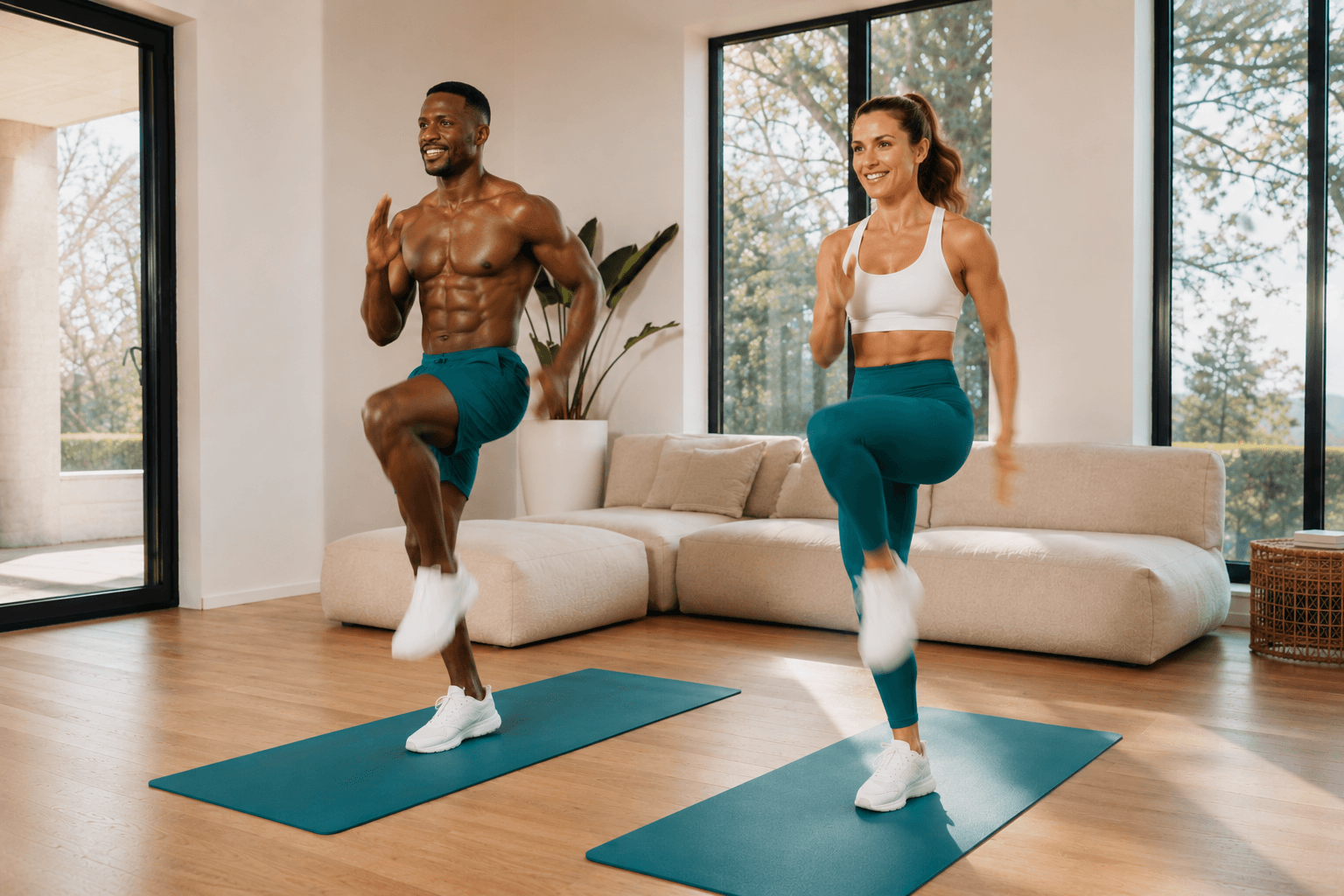
HIIT, or high-intensity interval training, is one of the most time-efficient ways to burn calories, improve your cardiovascular fitness and hold on to muscle — all using nothing but your own body weight. You work hard for a short burst, recover briefly, then go again. That simple rhythm pushes your heart rate up fast, which is exactly why an at-home HIIT workout is such a good fit for busy people who still want results.
No Time? No Problem
Honestly, for most people the biggest barrier to regular exercise isn’t motivation. It’s time.
Between work, family, commuting and everything else life throws at you, carving out an uninterrupted hour for the gym just isn’t realistic. That’s where HIIT changes the equation. Instead of training for a full hour, you can finish a genuinely challenging session in around 20 minutes — sometimes less.
However, that doesn’t mean it’s easy. It means every minute counts. A well-designed HIIT workout pairs short periods of hard effort with planned recovery, so you improve your fitness while making the most of the time you actually have. Whether you train before work, on a lunch break or after the kids are in bed, it slots into almost any schedule.
What You’ll Learn
- What HIIT actually is — and why it works so well
- The science behind the calorie burn
- The 10 best bodyweight HIIT exercises
- A complete 20-minute Sanook Fit workout
- Beginner-friendly modifications and common mistakes to avoid
- Recovery and nutrition tips to make your results stick
What Is HIIT?
To begin with, HIIT stands for high-intensity interval training. Rather than holding the same steady pace for your whole workout, you alternate between short periods of hard effort and brief recovery. A typical interval looks like 40 seconds of work followed by 20 seconds of rest, repeated several times.
That structure lets you train at a higher intensity than you could ever sustain continuously. It’s also endlessly flexible — you can dial it up or down to match your fitness, your space and the time you have. If you’re brand new to training, our complete bodyweight training guide for beginners is a gentle place to start before you add intervals.
Why HIIT Is So Effective
Ultimately, the appeal of HIIT comes down to efficiency. Because your work intervals are demanding, your body keeps using energy even after you’ve finished — an effect often nicknamed the “afterburn,” though the proper term is excess post-exercise oxygen consumption (EPOC). Once an intense session ends, your body keeps working to:
- Restore oxygen levels
- Repair muscle tissue
- Replenish energy stores
- Return your heart rate to normal
All of those processes take energy, which is part of what makes interval training feel so productive in such a short window.
Does HIIT Burn More Fat?
Naturally, this is one of the most common questions people ask, and the honest answer is a little more nuanced than most social media posts suggest. HIIT isn’t magic. Lasting fat loss still comes down to maintaining a sensible calorie balance over time. That said, HIIT genuinely supports fat loss because it burns calories during the session, keeps energy expenditure slightly elevated afterwards through EPOC, and — crucially — fits into a busy week so you can stay consistent. If your main goal is dropping body fat, pair these sessions with our best bodyweight workout for weight loss.
The Principles That Make HIIT Work
Before the exercises, it helps to understand the ideas that separate an effective interval session from one that just leaves you out of breath. Four principles matter most: working at a genuinely high (but controlled) intensity, respecting your recovery intervals, keeping your movement quality high, and applying progressive overload.
Progressive Overload
Similarly, just like strength training, HIIT should gradually get harder over time. You can progress by working a little longer, resting a little less, completing more rounds, or choosing tougher exercise variations.
Sanook Fit coach’s tip: The goal isn’t to finish completely wrecked. It’s to finish feeling like you worked hard while still moving well. Perfect technique beats sloppy speed every single time.
The 10 Best Bodyweight HIIT Exercises
Fortunately, a great HIIT workout doesn’t need complicated choreography or expensive kit. The best moves are simple, scalable and work several muscle groups at once — raising your heart rate while building strength, coordination and stamina. These are the movements we reach for again and again in our follow-along sessions over on the Sanook Fit YouTube channel, because they deliver for beginners and seasoned exercisers alike.
1. Burpees
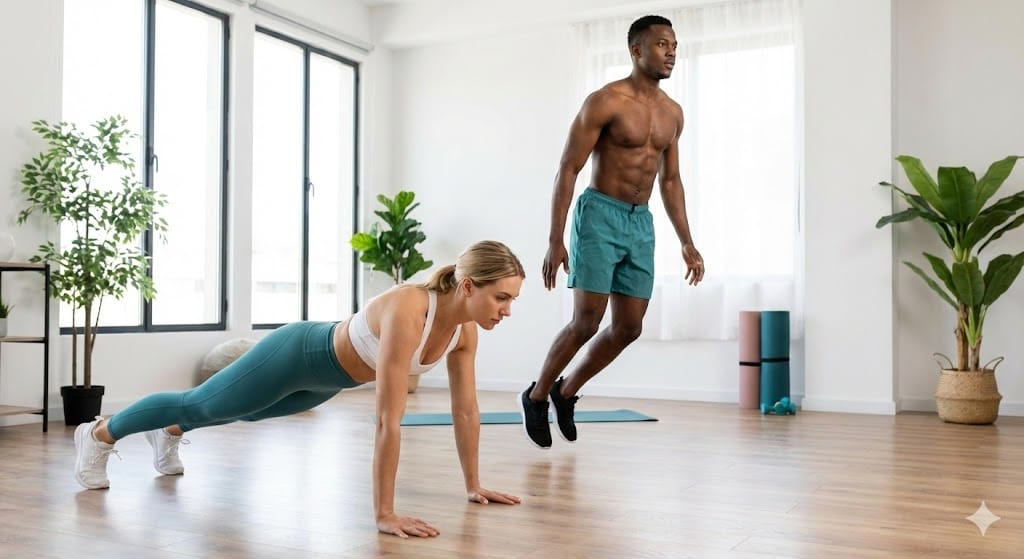
Difficulty: ⭐⭐⭐⭐⭐
Primary muscles: chest, shoulders, legs, core and your cardiovascular system.
In fact, few bodyweight exercises challenge your whole body the way a burpee does. It strings a squat, plank, push-up and jump into one continuous movement.
- Stand with your feet shoulder-width apart.
- Lower into a squat and place your hands on the floor.
- Jump or step your feet back into a plank.
- Perform a push-up (optional for beginners).
- Jump or step your feet back underneath you.
- Stand tall and jump with your arms overhead.
Beginner modification: step your feet back one at a time instead of jumping, and skip the push-up until you build confidence. Common mistakes: rounding your back, landing heavily, and rushing through low-quality reps. A controlled burpee usually burns more energy than a frantic one.
2. Mountain Climbers
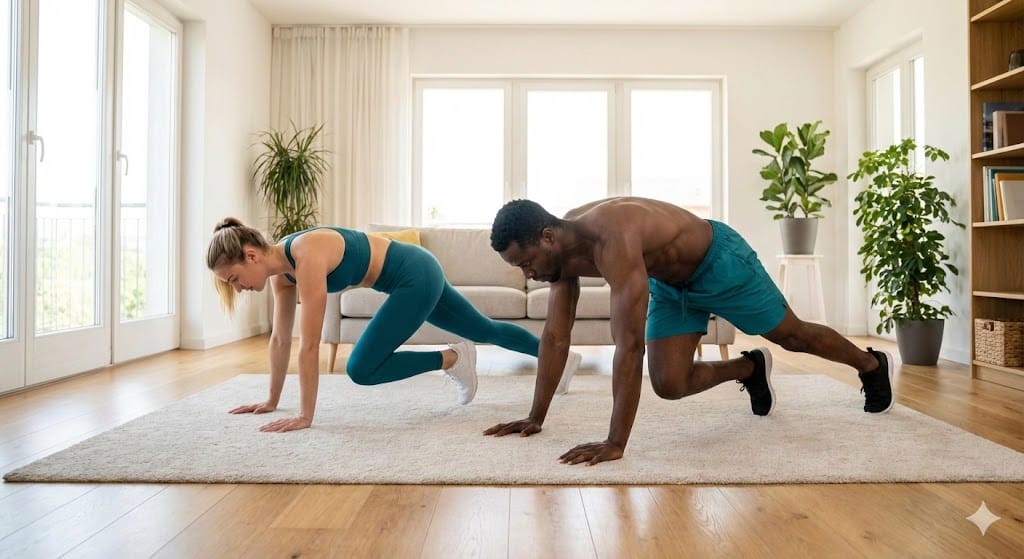
Difficulty: ⭐⭐⭐☆☆
Meanwhile, mountain climbers blend cardio with core training while strengthening your shoulders and sharpening coordination. Keep your hands below your shoulders, your core tight and your back flat, and drive each knee forward quickly but under control. For an easier version, slow it down into a marching tempo.
3. Air Squats
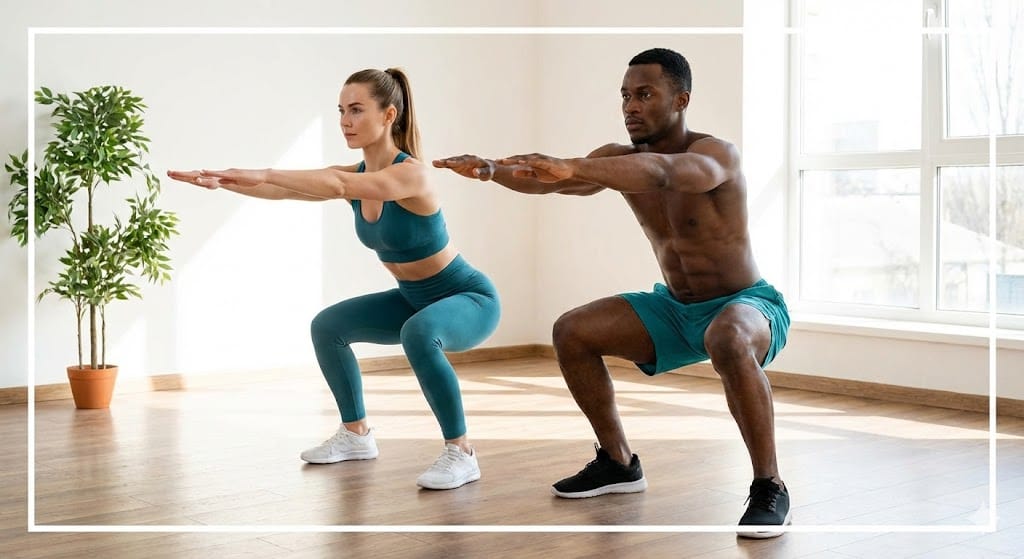
Difficulty: ⭐⭐☆☆☆
By contrast, air squats are simple, effective and suitable for almost everyone. They build lower-body endurance while keeping your heart rate up. Set your feet roughly shoulder-width apart, lift your chest, sit your hips back and drive up through your heels. Want to take your lower body further? Our no-equipment leg workout builds on exactly these basics.
4. Jumping Jacks
Next, jumping jacks — a classic warm-up and conditioning move — are easy to learn and quickly raise your heart rate. For a lower-impact version, step one foot out at a time instead of jumping — perfect for beginners or anyone with sensitive knees.
5. High Knees
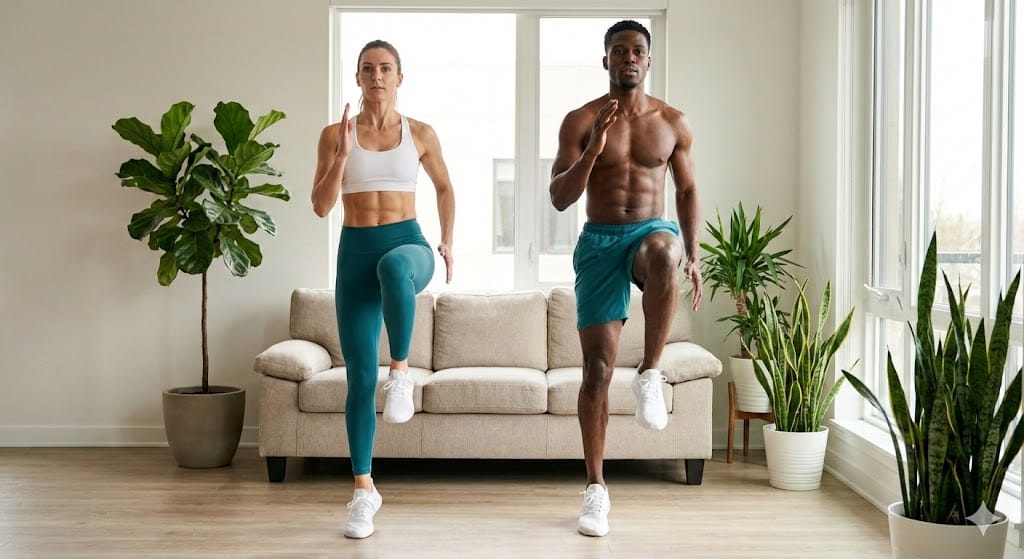
Difficulty: ⭐⭐⭐☆☆
Likewise, high knees build cardiovascular fitness, coordination and lower-body endurance all at once. Drive your knees toward waist height while pumping your arms naturally, land softly and stay light on your feet.
6. Reverse Lunges
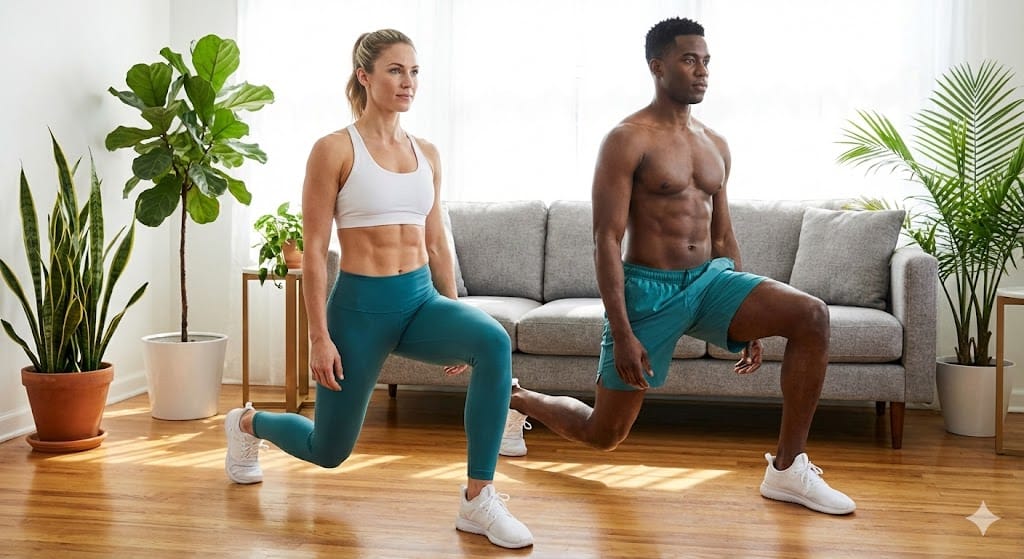
Additionally, reverse lunges strengthen your quads, glutes, hamstrings and core, and many people find them easier on the knees than forward lunges. Step back far enough to create two roughly 90-degree knee angles, then push through your front heel to return to standing.
7. Plank Shoulder Taps
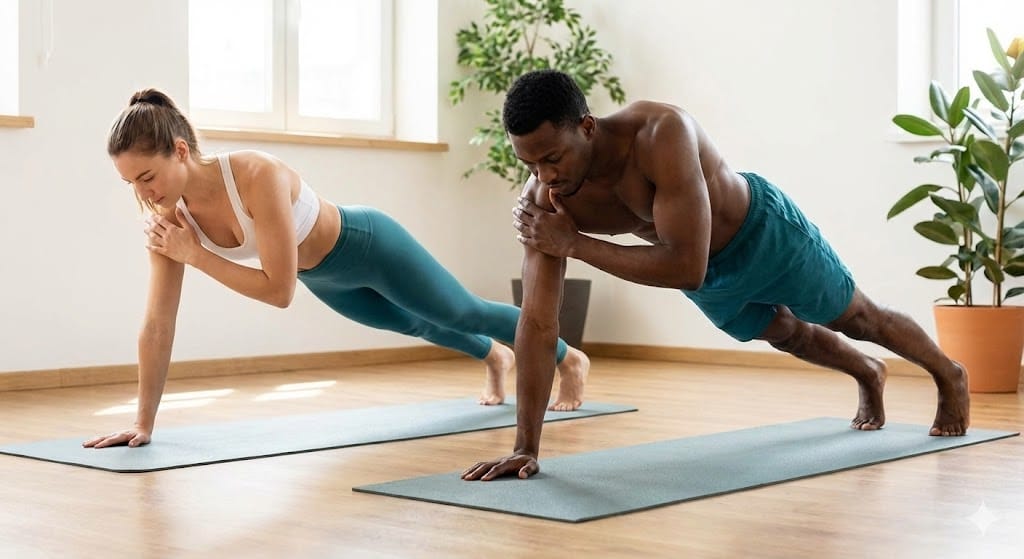
Meanwhile, each shoulder tap challenges your body’s ability to resist rotation. Move slowly enough that your hips stay almost perfectly still — imagine balancing a glass of water across your lower back.
8. Bear Crawl
Furthermore, the bear crawl — one of the most underrated bodyweight moves — strengthens your shoulders, chest, core, hips and legs while improving coordination. Take small, controlled steps and keep your knees hovering close to the floor.
9. Skater Hops
If athletic performance is one of your goals, skater hops earn their place. They build lateral power, balance, coordination and lower-body endurance. For a beginner version, step sideways instead of jumping.
10. Walk-Outs (Inchworms)
Finally, walk-outs combine flexibility, shoulder stability, core strength and mobility, which makes them an ideal low-impact alternative to burpees. Move slowly and don’t rush the return to standing. If mobility is a weak point for you, our home mobility routine pairs perfectly with this move.
Which HIIT Exercises Should You Choose?
Different movements develop different qualities, so the smartest sessions mix patterns rather than repeating one exercise on a loop. Use this quick reference to match an exercise to your main goal:
| Your Goal | Best Exercise |
|---|---|
| Beginners | Air Squats |
| Fat burning | Burpees |
| Core strength | Mountain Climbers |
| Low impact | Walk-Outs |
| Leg endurance | Reverse Lunges |
| Athletic performance | Skater Hops |
| Full body | Bear Crawls |
| Coordination | High Knees |
Low-impact HIIT is still HIIT. Swapping jumps for steps doesn’t make your session “easier” in any way that matters — it simply protects your joints while keeping the intensity where it needs to be.
Common HIIT Mistakes to Avoid
A few predictable errors quietly hold people back. Steer clear of these and your sessions will feel far more productive:
- Starting too fast. Many people sprint through the first minute and burn out. Pace yourself — consistency across the whole workout beats one explosive round.
- Ignoring recovery. Rest periods are part of the workout. Use them to breathe deeply and prepare for the next interval.
- Sacrificing technique. Quality movement always comes first. Poor form raises injury risk and reduces the benefit of every rep.
- Doing the same workout every week. Your body adapts quickly, so gradually change exercises, extend work intervals or trim your rest.
- Skipping the warm-up. Cold muscles aren’t ready for explosive movement. Spend a few minutes warming up before every session.
The Sanook Fit 20-Minute HIIT Workout
Above all, one of the biggest advantages of HIIT is its flexibility, because you don’t need a large space, expensive equipment or a free hour — 20 focused minutes is enough to challenge your heart, strengthen your muscles and lift your overall fitness. This session is built for the everyday home exerciser, whether you’re squeezing it in before work or unwinding with movement at the end of the day.
Warm-Up (4 Minutes)
Never skip your warm-up. Preparing your muscles and joints improves performance and lowers your injury risk. The aim here is simply to raise your heart rate and loosen up.
| Exercise | Time |
|---|---|
| March in place | 60 seconds |
| Arm circles | 30 seconds forward + 30 seconds backward |
| Bodyweight squats | 60 seconds |
| World’s greatest stretch | 30 seconds each side |
Main Workout
Work for 40 seconds, rest for 20 seconds, and complete four rounds. Finish all five exercises to complete one round, then repeat.
| Exercise | Work | Rest |
|---|---|---|
| Burpees | 40 sec | 20 sec |
| Mountain climbers | 40 sec | 20 sec |
| Air squats | 40 sec | 20 sec |
| Reverse lunges | 40 sec | 20 sec |
| Plank shoulder taps | 40 sec | 20 sec |
Exercise Coaching Notes
- Burpees: quality over speed — land softly, keep your core engaged, and step back instead of jumping if you need to.
- Mountain climbers: hold a strong plank, avoid bouncing your hips and drive each knee forward under control.
- Air squats: sit your hips back, keep your chest lifted and push through your heels as you stand.
- Reverse lunges: take a comfortable step back, control the descent and drive through your front leg to return.
- Plank shoulder taps: keep your hips square and move deliberately — imagine balancing a book across your lower back.
Scale It to Your Level
Encouragingly, the same five-move template works at every stage — you simply adjust the timing, rest and exercise selection. Pick the version that challenges you today, then progress as you get fitter.
Beginner Workout
First of all, if you’re new to HIIT, don’t worry about matching advanced athletes — start here and focus on learning clean movement while your fitness builds. Rest 30 seconds between exercises and repeat for three rounds.
| Exercise | Time |
|---|---|
| March in place | 30 sec |
| Bodyweight squats | 30 sec |
| Incline push-ups | 30 sec |
| Bird dogs | 30 sec |
| Step jacks | 30 sec |
If you want a structured on-ramp before adding intervals, work through our bodyweight training for beginners guide first.
Intermediate Workout
Then, once the beginner routine feels comfortable, progress to this circuit. Rest 30 seconds and complete four rounds.
| Exercise | Time |
|---|---|
| Burpees | 30 sec |
| Mountain climbers | 30 sec |
| Reverse lunges | 30 sec |
| High knees | 30 sec |
| Plank shoulder taps | 30 sec |
Advanced Workout
Ready for a real challenge? Rest only 15 seconds and repeat for five rounds, keeping your technique sharp even as fatigue builds. For more ideas at this level, see our guide to advanced bodyweight training.
| Exercise | Time |
|---|---|
| Burpees | 45 sec |
| Jump squats | 45 sec |
| Bear crawl | 45 sec |
| Skater hops | 45 sec |
| Cross-body mountain climbers | 45 sec |
How to Progress Your HIIT Workouts
Eventually, doing the same intervals week after week eventually leads to a plateau, so challenge yourself gradually. There are three reliable levers you can pull:
- Increase work time — build from 30 seconds in week one up to 45 seconds by week four.
- Reduce rest — step down from 30 to 20 to 15 seconds, but only if you can still hold good form.
- Add another round — rather than making every interval harder at once, simply tack on an extra round to raise the total volume.
Build a Balanced Weekly Schedule
HIIT is demanding, so recovery isn’t optional — it’s part of the plan. A balanced week lets you train hard on your interval days while giving your body time to adapt. Here’s one example that works well for most people:
| Day | Focus |
|---|---|
| Monday | HIIT |
| Tuesday | Upper body strength |
| Wednesday | Mobility & stretching |
| Thursday | HIIT |
| Friday | Lower body strength |
| Saturday | Core & full body |
| Sunday | Recovery walk |
This kind of structure improves your fitness while keeping the risk of overtraining low. If you’re still deciding where to train, our honest comparison of home workouts versus the gym is worth a read.
Recovery Matters
As a result, high-intensity training places real demands on your muscles and cardiovascular system, so treat recovery as part of the training process rather than an afterthought. Aim for seven to nine hours of sleep, plenty of water, nutritious meals, a little light stretching, and rest days between intense sessions. The better you recover, the better you’ll perform.
Nutrition for HIIT
In short, you don’t need a complicated diet to support interval training — just balanced meals built from three foundations:
- Lean protein to support muscle repair: chicken, fish, eggs, Greek yoghurt, tofu and lentils.
- Complex carbohydrates for sustained energy: oats, brown rice, sweet potatoes and wholegrain bread.
- Healthy fats to support hormones and overall health: avocados, nuts, seeds and olive oil.
Stay hydrated too — drink water before, during and after your session, since even mild dehydration can dent your performance.
Sanook Fit coach’s tip: Don’t judge a workout by how exhausted you feel afterwards. Judge it by whether you can repeat it next week with slightly better performance. Fitness isn’t built in one workout — it’s built across hundreds of them.
Frequently Asked Questions
Is a 20-minute HIIT workout enough?
Yes. A well-designed 20-minute session can meaningfully improve your cardiovascular fitness, burn calories and strengthen your muscles. The key is working at an intensity that challenges you while keeping your technique clean. If you can stay consistent with three or four sessions a week, 20 minutes is more than enough for most people.
Is HIIT better than running?
Neither is universally better. HIIT suits you if you have limited time, enjoy varied workouts, want to combine strength and cardio, or prefer short, intense sessions. Running shines for building aerobic endurance, relieving stress and getting outdoors. Many people benefit from doing both across the week.
Can beginners do HIIT?
Absolutely. The trick is choosing exercises that match your current fitness. Swap jumping movements for low-impact versions, focus on form, and build up gradually. Our beginner’s guide walks you through it step by step.
Should I do HIIT every day?
Probably not. HIIT places considerable stress on your muscles and cardiovascular system, so two to four sessions a week strikes the best balance for most people. On your other days, lean into walking, mobility work, strength training, gentle cycling or stretching.
Does HIIT build muscle?
Yes, particularly for beginners. Bodyweight HIIT can improve muscular endurance and stimulate growth, especially when you include push-ups, lunges, squats and burpees. To maximise muscle size, pair it with dedicated strength-focused bodyweight training.
Myth vs Reality
Meanwhile, the internet is full of exaggerated HIIT claims, so let’s separate fact from fiction. For a deeper dive, we’ve rounded up the biggest misconceptions in our bodyweight training myths debunked guide.
- Myth: “HIIT burns fat for 24 hours.” HIIT does raise calorie expenditure afterwards via EPOC, but the effect is modest. Long-term fat loss still depends on consistent training, nutrition and a sensible calorie balance.
- Myth: “The harder you train, the better.” Training at maximum effort every session usually leads to fatigue, not progress. Effective HIIT balances intensity with recovery.
- Myth: “Sweating means you’re burning more fat.” Sweat is just your body’s cooling system. Temperature, humidity, hydration and genetics all affect how much you sweat — it doesn’t measure calorie burn.
- Myth: “HIIT is only for athletes.” HIIT adapts to almost any fitness level. The intensity should challenge you, not match someone else’s workout.
Expert Coaching Advice from Sanook Fit
Notably, after coaching thousands of home workouts, one pattern stands out: the people who get lasting results don’t rely on motivation — they build routines. These are the habits we encourage every member of the Sanook Fit community to develop:
- Schedule your workouts. Treat a session like an important appointment. Adding it to your calendar makes it far more likely to happen.
- Focus on consistency. Missing one workout doesn’t matter; giving up completely does. Aim for steady progress over perfection.
- Master the basics. Simple exercises done well almost always beat complicated exercises done poorly. Strong fundamentals create long-term success.
- Listen to your body. Feeling challenged is normal; sharp pain isn’t. Modify when you need to and allow yourself proper recovery.
- Celebrate small wins. Progress isn’t only about body weight — finishing another round, recovering faster, cleaner technique and more energy all count, and they usually arrive long before visible changes do.
Build a Complete Fitness Routine
HIIT works best as one piece of a balanced plan rather than the whole thing. Combine it with strength training, mobility work and recovery, and you’ll progress faster with less burnout. If you like the variety, our fun full-body home workouts are an easy way to keep things fresh, and no-gym bodyweight sessions prove you never needed a membership in the first place.

Ready to Start?
You don’t need expensive equipment, a gym membership or even a spare hour. What you do need is the willingness to begin. Clear a small space in your living room, set a timer, choose a workout and start moving. Every session improves your fitness, builds confidence and moves you one step closer to your goals. The first workout is often the hardest — after that, momentum works in your favour.
Continue Your Sanook Fit Journey
Therefore, if you enjoyed this guide, keep building your home-fitness knowledge with these reads. Each one builds on the last to help you create a complete bodyweight training program:
- Can You Build Muscle Without Lifting Weights? — how bodyweight training builds real strength and muscle.
- Best Bodyweight Workout for Weight Loss — train smart to burn fat without any equipment.
- Bodyweight Training for Beginners — start safely with step-by-step guidance.
- The Ultimate Upper Body Workout — build your chest, shoulders and arms at home.
- No-Equipment Leg Workout — strengthen your lower body with simple, effective moves.
- Home Mobility Routine — improve flexibility, posture and recovery.
Join the Free 30-Day Sanook Fit Challenge
So, ready to stop searching and start training? The 30-Day Sanook Fit Challenge gives you a structured plan of short, follow-along workouts designed to fit into real life. Every workout is under 15 minutes, beginner-friendly, equipment-free, home-suitable and built to improve your strength, fitness and confidence. Whether your goal is losing weight, improving endurance or building healthier habits, the challenge helps you stay consistent one workout at a time. Subscribe on the Sanook Fit YouTube channel to follow along.
Final Thoughts
HIIT isn’t about chasing exhaustion. It’s about making every minute count. When you combine purposeful movement, progressive overload, balanced nutrition and enough recovery, you create a routine that’s both effective and sustainable. The best workout isn’t the one that leaves you flat on the floor — it’s the one you’ll come back to next week. Stay consistent, trust the process and keep showing up. Your future self will thank you.
Train With Us on Social
Want to follow real follow-along workouts and daily fitness inspiration? Join the Sanook Fit community across all our channels:
- YouTube — full-length follow-along HIIT and bodyweight workouts.
- Instagram — quick tips, form checks and motivation.
- TikTok — bite-sized workout ideas you can try today.
- Facebook — community updates and challenge announcements.
Trusted References
This guide draws on evidence-based guidance from leading exercise-science organisations: