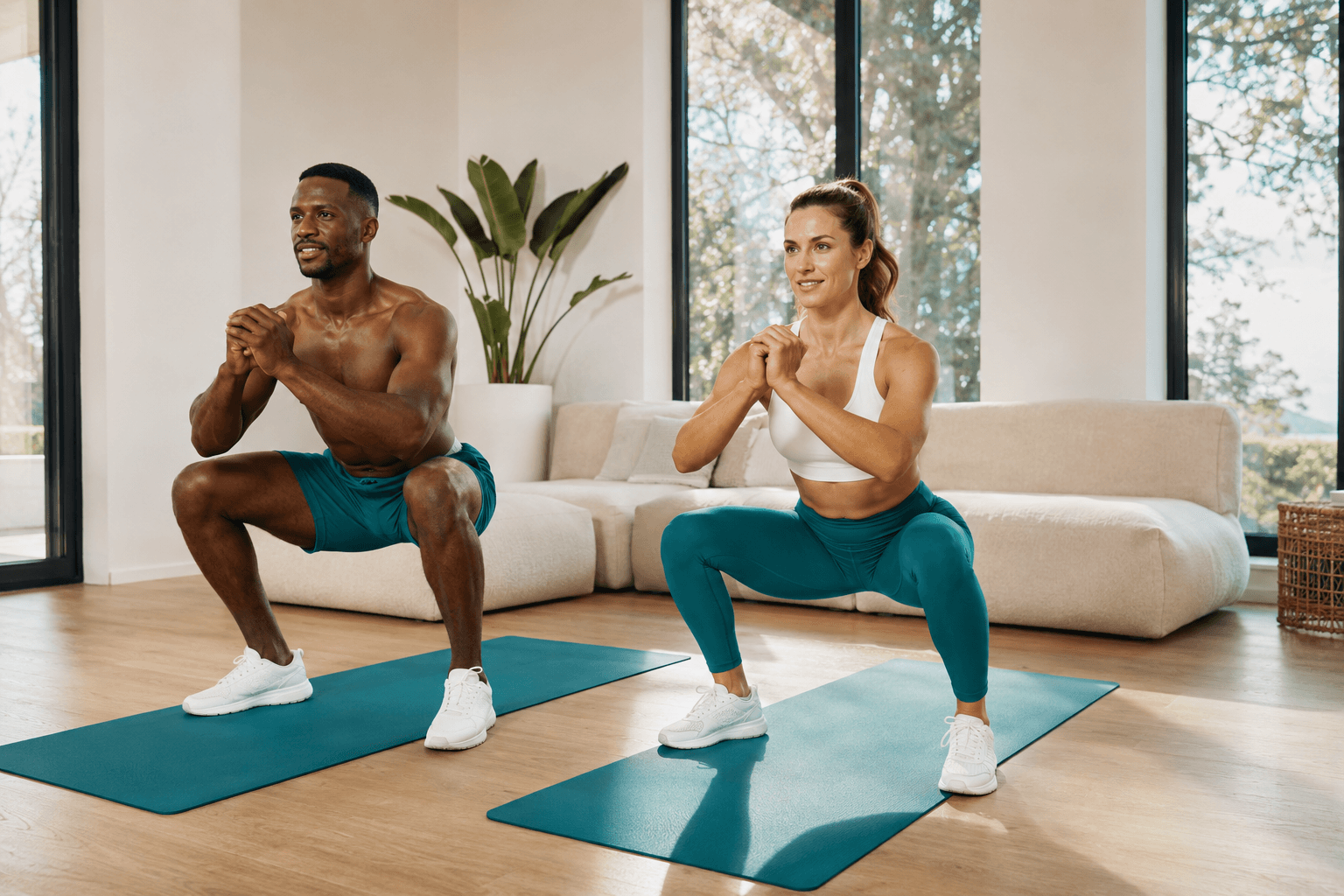
Remember how tough your very first push-up felt? Or how your legs shook through that first set of squats? Maybe holding a plank for 20 seconds once seemed impossible. Then, a few months later, those same movements started to feel… easy — a classic sign you’re ready for progressive overload bodyweight training. You finish a session barely out of breath, your numbers stop climbing, and a quiet question creeps in: “Have I hit my limit?”
You haven’t. What you’ve hit is a plateau — and the way through it is a principle called progressive overload. This complete progressive overload bodyweight guide shows you how to keep getting stronger using nothing but your own body weight, so your training keeps working for months and years to come.
Quick Answer: What Is Progressive Overload?
Progressive overload bodyweight training means gradually increasing the challenge placed on your muscles over time. Instead of adding weight to a barbell, you build strength by increasing repetitions, choosing harder exercise variations, slowing your tempo, shortening rest periods, improving your range of motion, or adding training volume. It’s the single most important principle for continued muscle growth, strength, and long-term progress.
What You’ll Learn in This Progressive Overload Bodyweight Guide
- The six proven ways to make any bodyweight exercise harder — without buying a single piece of equipment.
- How to know exactly when you’re ready to level up (and when you should hold steady).
- Full progression ladders for push-ups, squats, planks, and lunges.
- A sample 8-week plan you can follow straight away.
- The most common progression mistakes — and how to sidestep them.
As you’ll see, progressive overload is about far more than “just do more reps.” Effective progressive overload bodyweight training is about understanding how your body responds to a challenge and nudging it forward at the right pace. If you’re brand new to training without weights, our guide on whether you can build muscle without lifting weights is a great companion read.
The Golden Rule of Progression
Here’s the one rule that will save you months of frustration: never make two major changes at the same time. Instead of increasing your reps, your sets, and your exercise difficulty all in a single workout, pick one variable. Let your body adapt. Then progress again.
Small, consistent improvements almost always outperform dramatic jumps. This is exactly why we love progressive overload — it rewards patience over ego.
Why Consistency Beats Intensity
Picture two people. Person A trains incredibly hard once every two weeks. Person B completes three well-planned workouts every week for six months. Who ends up stronger? Almost certainly Person B.
Progressive overload only works when it’s supported by consistency. The strongest people we coach aren’t the ones who train the hardest on any single day — they’re the ones who keep showing up. If staying consistent is your struggle, you’ll find plenty of ideas in our guide to making exercise fun.
The 6 Progressive Overload Bodyweight Methods (No Weights Needed)
When you can’t simply load on more iron, you still have six powerful levers to pull. Master these and you’ll never run out of ways to challenge your body.
1. Increase Your Repetitions
The simplest place to start. If you can comfortably complete your target reps with clean form, add a few more next session. This builds muscular endurance and lays the foundation for tougher variations.
2. Choose a Harder Variation
This is the most effective lever for building raw strength. Moving from a knee push-up to a standard push-up, or from a squat to a single-leg variation, dramatically increases the demand on your muscles.
3. Slow Down Your Tempo
Time under tension matters. Lowering into a squat over four slow seconds is far harder than dropping in one. Slowing your tempo is a brilliant way to make an “easy” exercise feel brand new.
4. Shorten Your Rest Periods
Trimming rest between sets keeps your muscles working under fatigue and boosts conditioning. Reduce rest gradually — a 15-second cut is plenty to start.
5. Improve Your Range of Motion
A deeper squat or a fuller push-up recruits more muscle through a longer working range. Quality range of motion also protects your joints — something we cover in depth in our home mobility routine.
6. Increase Your Training Volume
Volume is simply your total work: sets multiplied by reps. Adding an extra set is a reliable way to keep progressing. For a deeper look at how much is ideal, see our science-based take on bodyweight training.
Which Progression Method Is Best for Your Goal?
There’s no single “best” method — the right choice depends on what you’re training for. Use this quick reference to match your goal to the most effective approach.
| Your Goal | Best Progression Method |
|---|---|
| Build Strength | Harder exercise variations |
| Build Muscle | Exercise difficulty + time under tension |
| Improve Endurance | More repetitions + shorter rest |
| Burn More Calories | Workout density + compound exercises |
| Improve Technique | Slower tempo + better range of motion |
| Break Plateaus | Combine two methods gradually |
Notice that adding more repetitions isn’t always the answer. Sometimes refining your technique or stepping up to a harder variation delivers far bigger rewards.
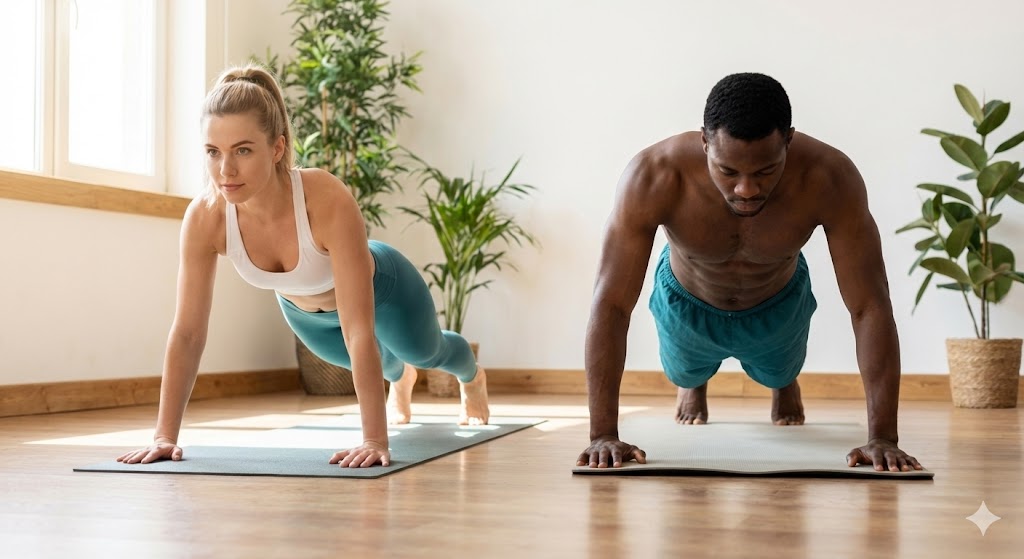
The Push-Up Progression Ladder
The push-up is the cornerstone of upper-body bodyweight strength. Master each stage with excellent form before climbing to the next.
- Wall Push-Up — perfect for complete beginners. Focus on straight body alignment and full range of motion. Goal: 15–20 perfect reps.
- Counter Push-Up — lower the angle so your body supports more weight. Goal: 15 controlled reps.
- Knee Push-Up — build pressing strength while keeping your hips aligned. Goal: 12–15 reps.
- Standard Push-Up — the foundation of upper-body strength. Goal: 15–20 clean reps.
- Decline Push-Up — elevate your feet to shift more load onto your shoulders and chest. Goal: 10–15 reps.
- Archer Push-Up — most of the work shifts to one arm, developing unilateral strength. Goal: 6–10 reps each side.
- One-Arm Push-Up Progression — a long-term goal demanding strength, stability, coordination, and patience.
Want a full upper-body session built around these movements? Follow along with our ultimate upper body workout at home.
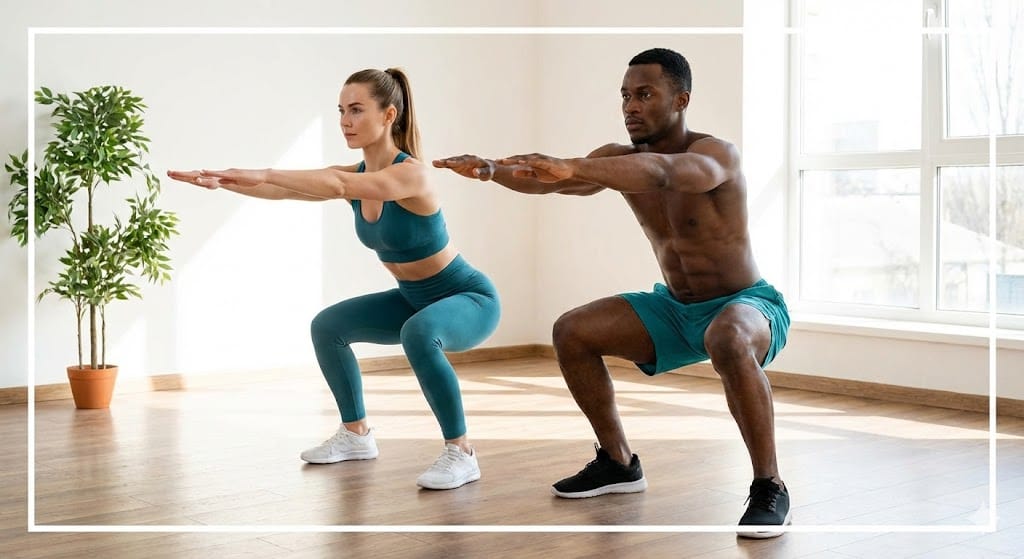
The Squat Progression Ladder
Squats build lower-body strength, mobility, balance, and coordination. Don’t rush toward advanced variations — a flawless standard squat earns its place first.
- Supported Squat — hold a sturdy surface for balance as you learn the pattern.
- Box Squat — sit back to a chair or bench to groove consistent depth.
- Standard Squat — your foundation. Aim for controlled depth and an upright chest.
- Tempo Squat — lower over four slow seconds to multiply time under tension.
- Bulgarian Split Squat — elevate the rear foot to load one leg at a time.
- Pistol Squat Progression — the single-leg milestone demanding strength, mobility, and balance.
Progression goal: don’t attempt a pistol squat until standard squats feel easy with excellent control.
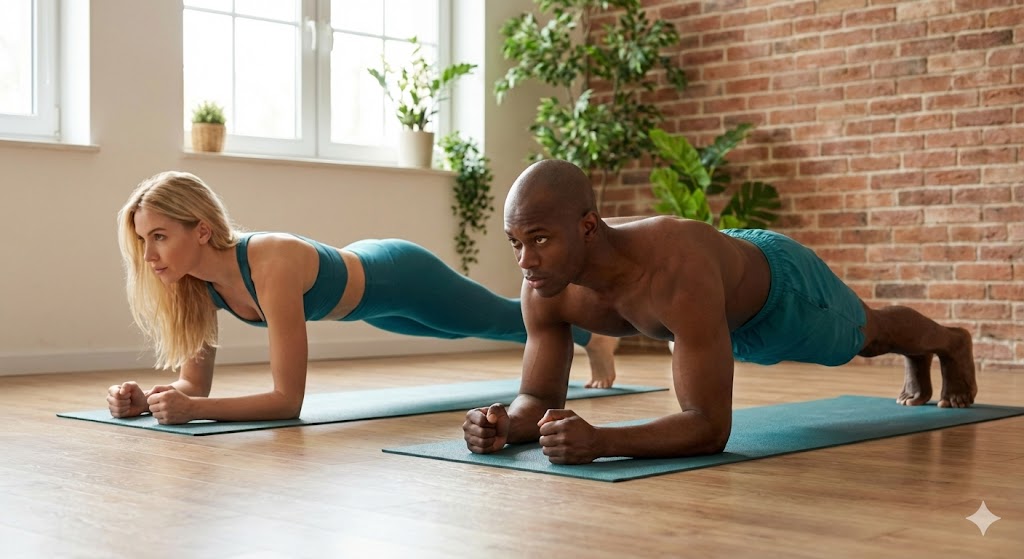
The Plank Progression Ladder
Core training isn’t about holding a plank forever — it’s about increasing the challenge intelligently. Climb this ladder one rung at a time.
- Incline Plank
- Knee Plank
- Forearm Plank
- High Plank
- Shoulder Tap Plank
- Plank Walk
- Body Saw Plank — one of the most challenging bodyweight core exercises.
Coaching tip: if your hips start rotating, drop back to the previous level. A stable, controlled plank beats a wobbly hold every time.
The Lunge Progression Ladder
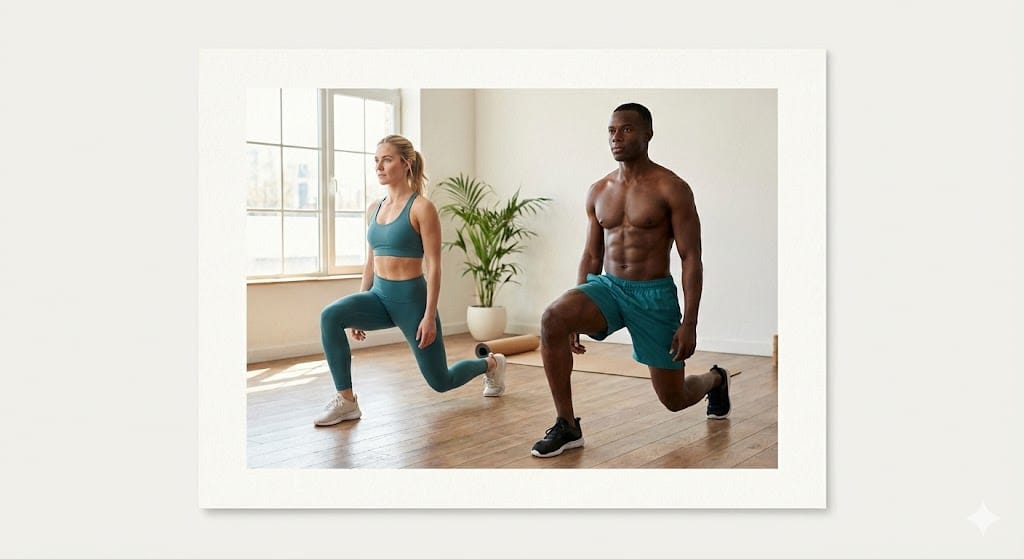
Lunges improve balance, hip stability, and athletic performance. Build control before you add power.
- Split-Stance Hold
- Supported Reverse Lunge
- Reverse Lunge
- Forward Lunge
- Walking Lunge
- Deficit Lunge — stand on a low, stable platform to increase your range of motion.
- Jumping Lunge — power, speed, and coordination combined.
These movements fit perfectly into a complete lower-body or 15-minute full body workout when you’re short on time.
How to Know You’re Ready to Progress
Before moving to a harder variation, run through this quick self-check. If you can honestly answer “yes” to all four, you’re ready to level up.
- ✅ Can I complete every repetition with excellent form?
- ✅ Am I controlling the movement instead of relying on momentum?
- ✅ Am I breathing comfortably throughout each set?
- ✅ Does this variation feel consistently manageable?
When NOT to Progress
Hold at your current level if your form breaks down, you compensate with poor movement patterns, you feel persistent pain, or you can’t hit your planned reps consistently. Progress isn’t a race — mastery comes before advancement. Training safely is the foundation of everything; our complete guide to building muscle without weights reinforces why patient progression pays off.
A Sample 8-Week Progressive Overload Bodyweight Plan
Here’s how progressive overload looks in practice, using the push-up as an example. Adjust the starting level to match your current ability — the structure matters more than the exact numbers.
| Week | Exercise | Goal |
|---|---|---|
| 1 | Counter Push-Up | 3 × 10 |
| 2 | Counter Push-Up | 3 × 12 |
| 3 | Knee Push-Up | 3 × 10 |
| 4 | Knee Push-Up | 3 × 12 |
| 5 | Standard Push-Up | 3 × 8 |
| 6 | Standard Push-Up | 3 × 10 |
| 7 | Standard Push-Up | 3 × 12 |
| 8 | Decline Push-Up | 3 × 8 |
See the pattern? You progress one variable at a time and let your body adapt before raising the bar again. That’s progressive overload in its simplest, most sustainable form.
Progress Isn’t Always Linear
Some weeks you’ll improve rapidly. Other weeks you’ll simply hold your ground — and that’s completely normal. Maintenance weeks are part of successful training, not a sign of failure. The goal is steady progress over months, not a personal best every single session. For more myth-busting on what actually drives results, read our piece on bodyweight training myths debunked.
The Sanook Fit Progress Checklist
Before you progress any exercise, run through this final checklist. It keeps your ego in check and your joints happy.
- ✅ Can I perform every rep with excellent technique?
- ✅ Can I control the movement through a full range of motion?
- ✅ Am I recovering well between workouts?
- ✅ Have I truly mastered my current variation?
- ✅ Am I progressing for the right reason — not just out of impatience?

Expert Coaching Advice From Sanook Fit
One of the biggest lessons we’ve learned coaching our community is this: the strongest people aren’t the fastest learners — they’re the most consistent ones. Here’s the advice we share with every Sanook Fit member.
Respect the Basics
Never underestimate simple exercises. A perfect push-up, a perfect squat, and a perfect plank stay valuable throughout your entire training journey. Polished fundamentals build the strongest foundation.
Track Your Progress
What gets measured gets improved. Jot down your reps, your variations, and how each session felt. A simple log turns vague effort into clear, motivating progress.
Train the Whole Body
Chasing a single skill is fun, but balanced strength keeps you healthy and injury-free. Mix pushing, squatting, core, and single-leg work each week. Our fun full-body workouts make that easy and enjoyable.
Frequently Asked Questions
Can you really build muscle without weights?
Yes. As long as you apply progressive overload — harder variations, more reps, slower tempo, and so on — your muscles keep receiving the stimulus they need to grow. The principle is identical to weight training; only the tools differ.
How often should I progress?
There’s no fixed timeline. Progress when an exercise feels consistently manageable with excellent form — often every one to three weeks. Rushing only invites poor technique and frustration.
How many days a week should I train?
Three well-planned sessions per week is a fantastic starting point for most people, leaving room to recover and adapt. Consistency over six months beats heroic effort once a fortnight every time.
What if I plateau on every exercise at once?
Plateaus are usually a recovery or consistency issue rather than a strength one. Check your sleep, nutrition, and weekly frequency before assuming you’ve hit a ceiling. A short deload week often unlocks fresh progress.
Keep Levelling Up
Progressive overload is the engine behind every bit of strength you’ll ever build — with or without weights. The beauty of progressive overload bodyweight training is its simplicity: pick one variable, master it, and move forward with patience. Do that consistently and your body will keep adapting for years to come.
Ready to put it into practice? Join the Sanook Fit community and train along with us — we’d love to cheer you on.
Follow Sanook Fit for daily no-equipment workouts:
YouTube • TikTok • Facebook • Instagram
Continue Your Bodyweight Journey
These cornerstone Sanook Fit guides pair perfectly with progressive overload bodyweight training — together they help you choose the right exercises, train safely, and keep improving without equipment:
- Advanced Bodyweight Training: Build Serious Strength Without Weights
- The Ultimate Upper Body Workout at Home
- 15-Minute Full Body Workout at Home
- The Best Bodyweight Workout for Weight Loss
- The Ultimate Home Mobility Routine
- Home Workouts vs Gym: Which Is Better?
- 15 Bodyweight Training Myths Debunked
- How to Make Exercise Fun
- No Gym? No Problem – Fun Bodyweight Workouts at Home
- The Sanook Fit Workout Video Library
- About Sanook Fit
Together, these guides form a complete learning path — from choosing the right exercise to progressing safely and staying consistent for the long haul.