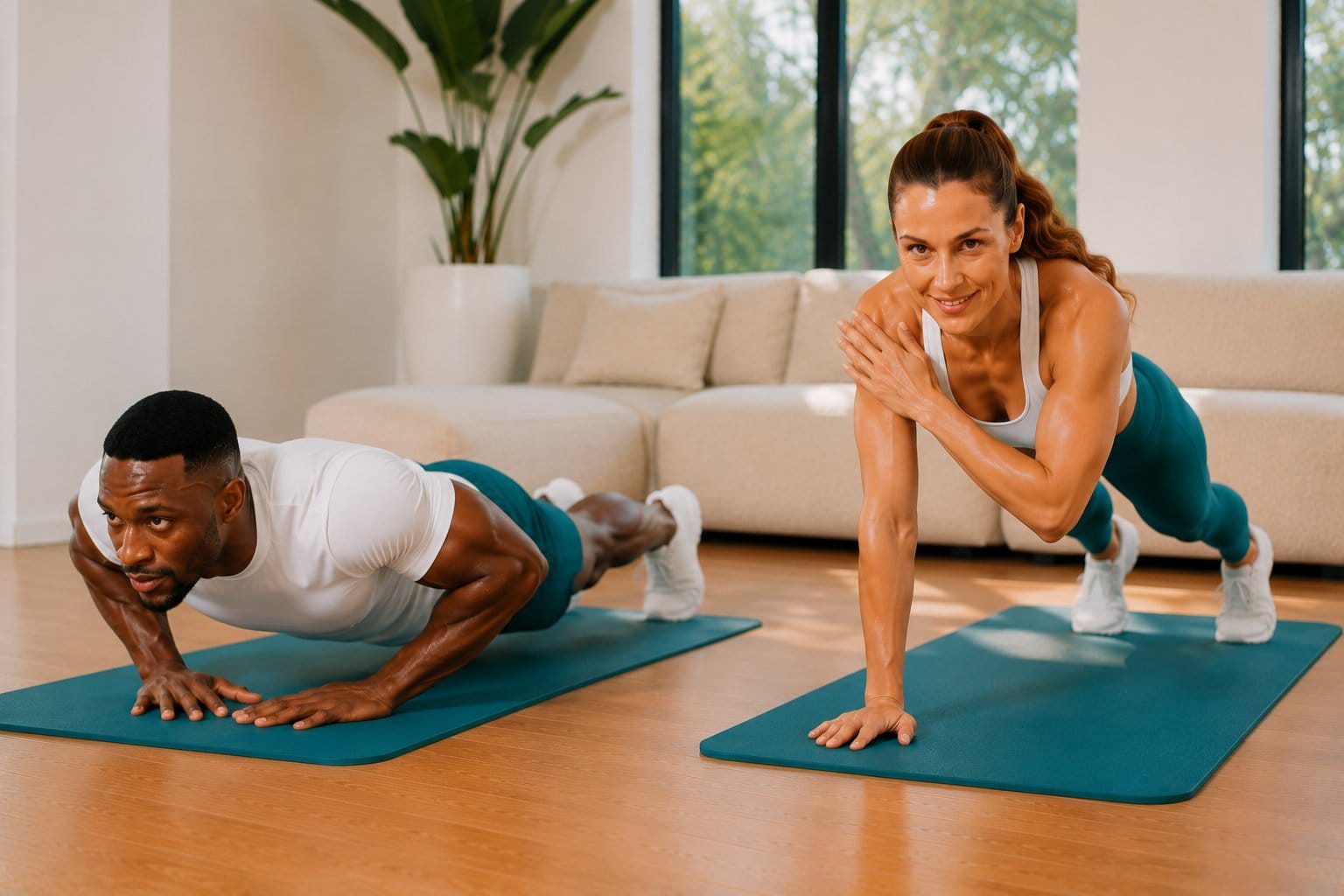
Build a Strong Upper Body Workout at Home Without a Gym
When most people picture upper-body training, they imagine racks of dumbbells, cable machines, and heavy bench presses. However, the truth is far simpler. In fact, you can build a strong, capable body with a smart upper body workout at home and nothing more than your own body weight. Because bodyweight moves teach your muscles to work as a team, they build the kind of strength you actually use every day.
Whether you are pushing a heavy door, carrying groceries, lifting a child, or moving furniture, your chest, shoulders, back, arms, and core all fire together. Therefore, you don’t need pricey gear to get stronger. Instead, you need the right moves, solid form, and a plan you can stick to. As a result, this guide shows you exactly how to train your upper body from home, with clear steps for beginners through advanced exercisers.
What Muscles Does an Upper Body Workout at Home Train?
Your upper body includes several major muscle groups, and they all work together during everyday movement. Because of this teamwork, a balanced upper body workout at home should challenge each area. So let’s break down what you are training and why it matters.
Chest (Pectorals)
Your chest muscles do a lot of the heavy lifting when you push. As a result, strong pecs help you:
- Push objects away from your body
- Perform push-ups with control
- Get up from the floor with ease
- Stabilize your shoulders during pressing moves
Shoulders (Deltoids)
Your shoulders give your arms their range of motion. Therefore, they help you:
- Lift your arms overhead
- Reach in different directions
- Throw and carry objects
- Stay stable during many exercises
Furthermore, strong shoulders improve mobility while lowering your risk of injury during daily tasks.
Back
The back includes several important muscles, such as the trapezius, rhomboids, latissimus dorsi, rear deltoids, and erector spinae. Together, these muscles support good posture, a strong pulling motion, and a healthy spine. Because most of us sit too much, back training matters more than ever.
Arms (Biceps and Triceps)
Your arms assist nearly every push and pull. While the triceps drive pressing moves, the biceps handle pulling. Consequently, a well-rounded routine trains both, even without dumbbells.
Core
Finally, your core ties everything together. Since it stabilizes your spine during every rep, a strong core makes each upper-body move safer and more powerful. To learn how it all connects, explore our guide on why your body is the ultimate weight room.
Before You Start: Set a Strong Foundation
Before you chase advanced moves, master the basics first. Because a solid base leads to safer, more lasting progress, take your time with each exercise. Moreover, good form now saves you from setbacks later. If you are brand new to training, our beginner calisthenics progression guide walks you through your very first push-up step by step.
What You’ll Learn in This Upper Body Workout Guide
In the sections ahead, you will discover:
- The best bodyweight exercises for your chest, shoulders, back, and arms
- Proper technique for every movement
- Beginner and advanced variations
- Sample upper-body workouts you can follow today
- Common mistakes to avoid
- How to keep progressing without any equipment
Building strength doesn’t require a gym full of machines. Rather, it starts with mastering the movements your body was designed to perform.
The Best Bodyweight Exercises for Your Upper Body Workout at Home
The best routines don’t rely on dozens of moves. Instead, they focus on a handful of highly effective compound exercises that hit several muscles at once. Because these moves build real, functional strength, they belong in every upper body workout at home. So let’s explore the foundation of a smart training plan.
Chest Exercises
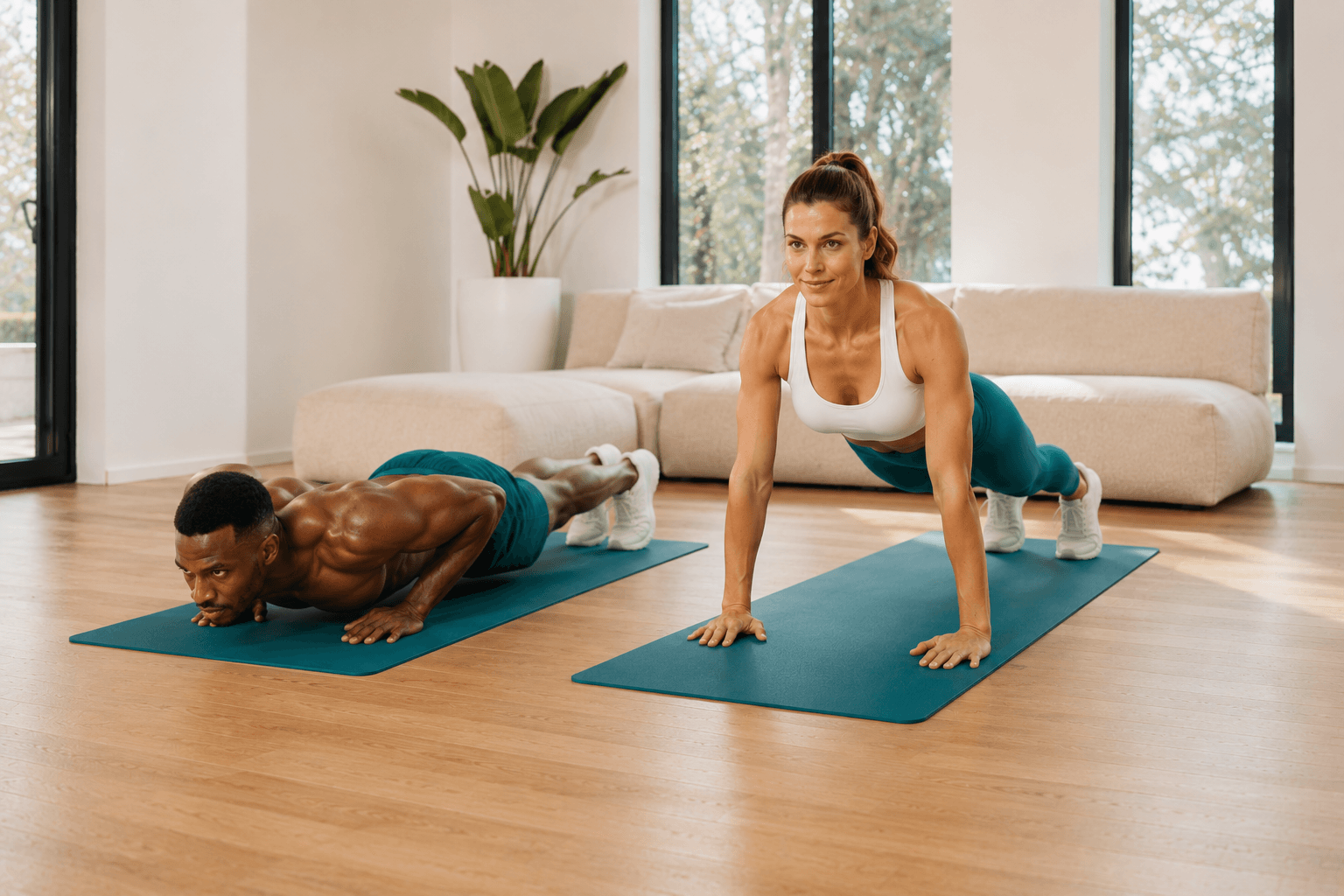
1. Standard Push-Up
Primary muscles worked: chest, triceps, front shoulders, and core. The push-up is one of the most complete upper-body moves you can do. Because it also asks your core and glutes to stay tight, it trains far more than your chest.
- Begin in a high plank position.
- Place your hands slightly wider than shoulder width.
- Brace your core.
- Lower your chest toward the floor by bending your elbows.
- Press back to the start.
Common mistakes: sagging hips, flaring elbows, and rushing each rep. Easier variation: wall or incline push-up. Harder variation: archer or decline push-up.
2. Wide Push-Up
By setting your hands wider, you shift more work to the chest. Otherwise, the setup mirrors the standard push-up. As a bonus, it stretches the pecs a little more at the bottom.
Shoulder Exercises
3. Pike Push-Up
Primary muscles worked: shoulders, triceps, and upper chest. Because it places more load on the shoulders than a standard push-up, it builds real overhead pressing strength.
- Start in an inverted “V” position with hips high.
- Bend your elbows.
- Lower the top of your head toward the floor.
- Press back to the start.
Common mistakes: dropping the hips, looking too far forward, and moving too fast. Easier variation: elevate your hands on a sturdy surface. Harder variation: feet-elevated pike push-up.
4. Plank Shoulder Taps
This move improves shoulder stability while your core resists rotation. Consequently, it builds control that carries over to almost every exercise.
- Begin in a high plank.
- Lift one hand to tap the opposite shoulder.
- Return with control.
- Alternate sides.
Common mistakes: rotating the hips, rushing, and letting the shoulders collapse.
Back Exercises
5. Superman Hold
Primary muscles worked: lower back, glutes, and rear shoulders. Because most home routines skip the back, this move helps you stay balanced.
- Lie face down with your arms in a “Y” shape.
- Lift both arms and legs from the floor.
- Pause briefly at the top.
- Lower slowly.
Common mistakes: arching the lower back too hard, shrugging the shoulders, and using momentum.
6. Doorway or Towel Rows
To train a true pulling motion at home, use a sturdy doorway or a towel looped around a solid post. Then row your chest toward your hands while squeezing your shoulder blades. As a result, you strengthen the muscles that improve posture.
7. Reverse Snow Angels
Lie face down, then sweep your arms from overhead down to your hips while keeping them lifted. Because the movement is small and controlled, it wakes up the upper back beautifully.
Arm Exercises
Most bodyweight arm training happens during compound moves. Still, a few targeted exercises give your arms extra attention.
8. Chair Triceps Dips
Primary muscles worked: triceps, chest, and front shoulders. Because chair dips emphasize the triceps while also building pressing strength, they add great variety.
- Sit on a sturdy chair.
- Place your hands beside your hips.
- Slide forward off the seat.
- Lower until your elbows reach roughly 90 degrees.
- Press back up.
Common mistakes: dropping too low, rounding the shoulders, and moving too quickly. Easier variation: keep your knees bent. Harder variation: straighten your legs or elevate your feet.
9. Bear Crawl
Primary muscles worked: shoulders, chest, triceps, core, and legs. Because it demands total-body coordination, the bear crawl builds endurance and stability at once.
- Begin on your hands and feet with your knees hovering just above the floor.
- Move one hand and the opposite foot forward together.
- Continue with small, controlled steps.
Common mistakes: raising the hips too high, taking large uncontrolled steps, and losing core tension.
Sample Upper Body Workout at Home Routines
Now that you know the moves, let’s put them together. Because your level shapes your plan, pick the routine that matches you today. Then, as you get stronger, simply move up. For extra follow-along sessions, our Sanook Fit YouTube channel has full workouts you can train to in real time.
Beginner Routine
- Wall or incline push-ups — 3 sets of 8
- Plank shoulder taps — 3 sets of 10
- Superman holds — 3 sets of 20 seconds
- Chair triceps dips (knees bent) — 3 sets of 8
Intermediate Routine
- Standard push-ups — 4 sets of 10
- Pike push-ups — 3 sets of 8
- Towel rows — 4 sets of 10
- Bear crawl — 3 rounds of 30 seconds
Advanced Routine
- Archer or decline push-ups — 4 sets of 8
- Feet-elevated pike push-ups — 4 sets of 6
- Towel rows (slow tempo) — 4 sets of 12
- Chair dips (legs straight) — 4 sets of 12
Rest for 30 to 60 seconds between sets. However, feel free to adjust based on how you feel that day. Above all, quality reps beat rushed ones.
How to Keep Progressing Without Equipment
Your muscles adapt fast, so a good upper body workout at home needs steady progress. Fortunately, you can keep challenging your body without adding weight. Here are four simple ways to level up.
1. Add Tension by Slowing Down
Slow each rep to make it harder. For example, lower yourself during a push-up over three to five seconds, pause at the bottom, then press up with control. As a result, your muscles work more without any extra load.
2. Increase Your Training Volume
You can also progress by gradually adding reps, sets, or total workout time. However, increase only one variable at a time so you avoid burning out.
3. Reduce Your Rest Time
Shorter breaks push your muscles and heart harder. Therefore, try trimming rest from 30 seconds to 20, then to 15 as you improve.
4. Progress to Harder Variations
As your strength grows, move to tougher versions of each move. For instance, go from a wall push-up to a standard push-up, and then to an archer push-up. This idea is called progressive overload, and you can read more about maximizing it in our guide on getting better results from home workouts.
Recovery Makes Your Upper Body Workout at Home Work
Training breaks your muscles down, but recovery builds them back stronger. Because of this, rest days are not lazy days; they are part of the plan. Moreover, sleep, hydration, and light movement all speed up your progress. To dig deeper, see our article on why recovery builds real strength.
How Long Until You See Results?
Everyone progresses at a different pace. Because your starting level, sleep, nutrition, consistency, and genetics all play a role, results vary from person to person. Still, many people notice real changes within four to eight weeks, such as:
- Better muscular endurance
- Easier, cleaner push-ups
- Improved posture
- Greater shoulder stability
- More confidence during workouts
Visible muscle growth usually takes longer, especially if size is your main goal. However, strength often shows up first, so celebrate those early wins. If the scale frustrates you, our guide on tracking progress without a scale shows better ways to measure success.
Nutrition Supports Your Upper Body Workout at Home
Exercise gives your body the signal to change, while nutrition helps it recover and adapt. Therefore, aim for sustainable habits rather than harsh, restrictive diets. To fuel your training, include:
- Lean protein to support muscle repair
- Whole grains for steady energy
- Fruits and vegetables for vitamins, minerals, and fiber
- Healthy fats from nuts, seeds, avocados, and olive oil
- Plenty of water throughout the day
For evidence-based nutrition and activity basics, the World Health Organization’s physical activity guidance is a helpful, trustworthy starting point.
Train With Sanook Fit
You don’t have to train alone. Because guided sessions keep you consistent, our free workouts make it easy to show up. Every routine offers functional movement, beginner-friendly cues, short and effective sessions, and scalable difficulty. So whether your goal is your first push-up, stronger shoulders, or better posture, we help you build strength one session at a time.
Follow along and stay motivated on our channels: YouTube, TikTok, Facebook, and Instagram.
Final Thoughts on Your Upper Body Workout at Home
Strong arms, shoulders, chest, and back are not built overnight. Instead, they come from hundreds of well-performed reps, steady progression, and consistent practice. Because your body already carries everything you need, you can start today. So master the fundamentals, train with control, and recover well. Over time, those small wins add up to real strength, better posture, and lasting confidence. Ultimately, your body is capable of far more than you might think, and all it needs is a plan and your commitment.
References
- World Health Organization — Physical Activity Fact Sheet: who.int/news-room/fact-sheets/detail/physical-activity
- American Council on Exercise — Bodyweight Training Basics: acefitness.org/resources/everyone/exercise-library
- Centers for Disease Control and Prevention — Physical Activity Basics: cdc.gov/physical-activity-basics