You’ve been showing up consistently. Your workouts are getting done, your eating habits are improving, and honestly — you feel different. But then you step on the scale, and the number hasn’t budged. Or worse, it’s crept up slightly. That single digit threatens to unravel everything. Sound familiar? Here’s what you need to hear. Learning how to track fitness progress without a scale might be the single most important shift you make in your entire fitness journey. The scale measures one thing: gravitational pull on your total body mass. And that one thing tells you almost nothing about your actual health, strength, or body composition.
In this guide, we’ll walk you through seven genuinely reliable signs that your home workouts are working. We’ll also explain why body weight is such an unreliable primary metric. And you’ll learn how to build a progress tracking system that keeps you motivated through every phase — including the phases where the scale refuses to cooperate.
💡 Quick Answer: To track fitness progress without a scale, monitor strength improvements (more reps, harder variations), endurance gains, progress photos, body measurements, energy levels, how your clothes fit, and how easily you perform daily activities. Together, these metrics give you a far more accurate picture of your actual progress than body weight alone.
Why the Scale Is Such a Poor Measure of Fitness Progress
Before we get into the seven better metrics, it’s worth understanding exactly why body weight is so misleading. Once you grasp this, you’ll never feel gut-punched by the scale again. Once you understand this, it becomes far easier to track fitness progress without a scale and trust what your body is telling you.
Your body weight at any given moment reflects a lot of things at once. That includes your bones, organs, muscle tissue, fat tissue, water, undigested food, and even the air in your lungs. Every one of those factors fluctuates daily — often by 1–3 kilograms (2–6 pounds) for no fitness-related reason at all. Weigh yourself on a Tuesday morning after a salty meal and a poor night’s sleep, and you’ll get one number. Weigh yourself Wednesday morning after eight hours of sleep and plenty of water, and you’ll get a completely different one. Yet your body composition hasn’t changed at all.
Something else happens when you begin exercising consistently, especially with resistance-based training like the bodyweight workouts Sanook Fit specializes in. Your body often loses fat and gains muscle at the same time. Muscle tissue is denser than fat tissue. So your body can become visibly leaner, stronger, and more defined while your scale weight stays essentially the same, or even increases slightly. This is one of the most demoralizing traps in home fitness. The good news: it’s completely avoidable once you know how to track fitness progress without a scale.
7 Signs Your Home Workouts Are Working (That Have Nothing to Do With the Scale)
Sign 1: You’re Getting Stronger
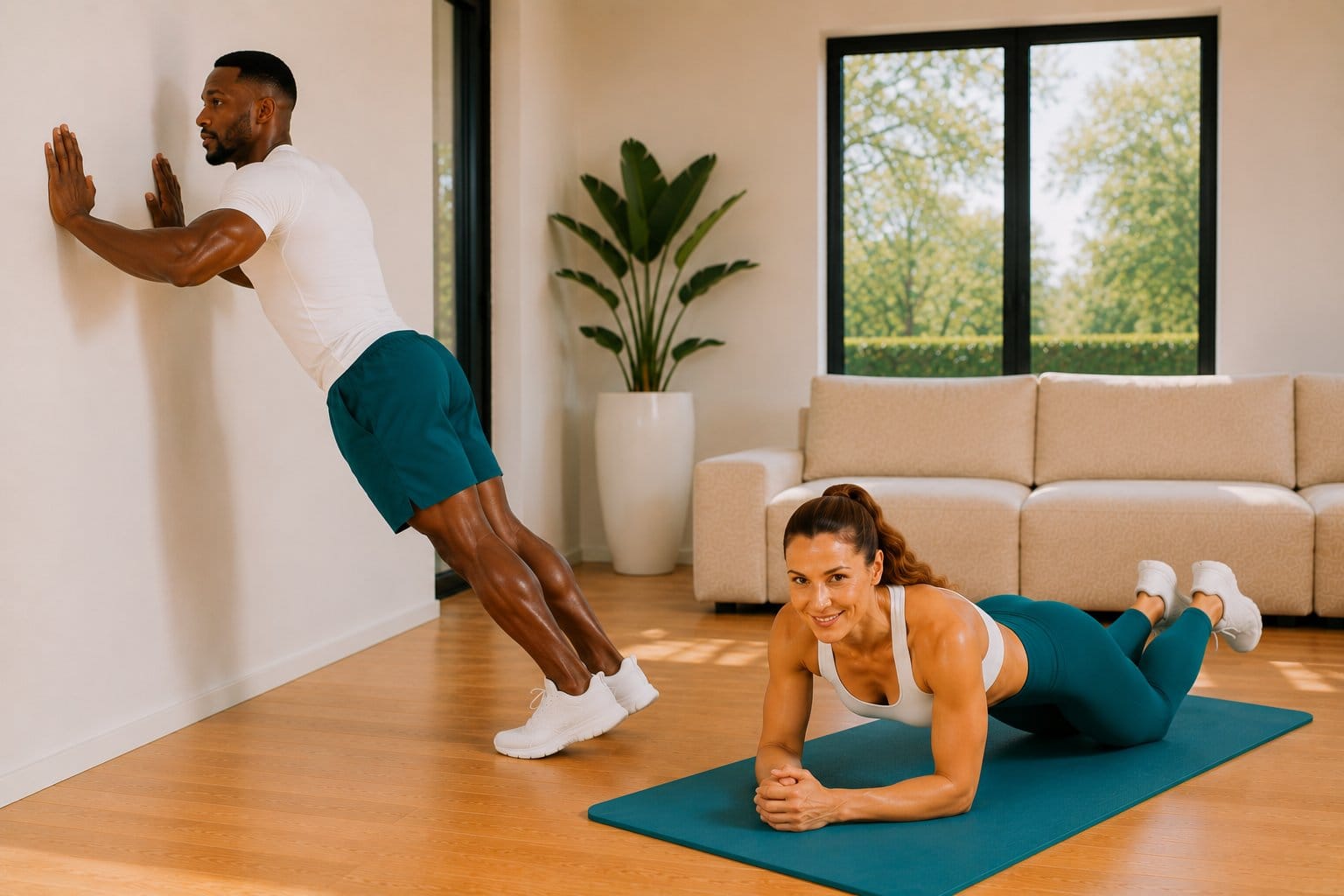
Strength progression is arguably the clearest, most objective way to track fitness progress without a scale — and it’s also the most immediately satisfying. When you started, maybe you could barely manage a wall push-up. Now you’re doing twelve knee push-ups with textbook form. Next month, you’ll hit your first full push-up. That progression is irrefutable evidence that your training is working.
Look for signs of strength improvement across all your movements:
- You’re performing more reps of the same exercise with the same effort level
- You’ve progressed to a harder variation (wall push-ups → incline push-ups → knee push-ups → full push-ups)
- You’re completing your sets with less rest between them
- Exercises that felt genuinely difficult three weeks ago now feel manageable
- Your posture has improved — which indicates core and back strength are developing
Strength gains happen at the muscular and neurological level at the same time. So even the first two weeks of consistent training produce measurable improvements in what you can physically do. That’s well before any significant aesthetic changes become visible.
Sign 2: Better Endurance Helps You Track Fitness Progress Without a Scale
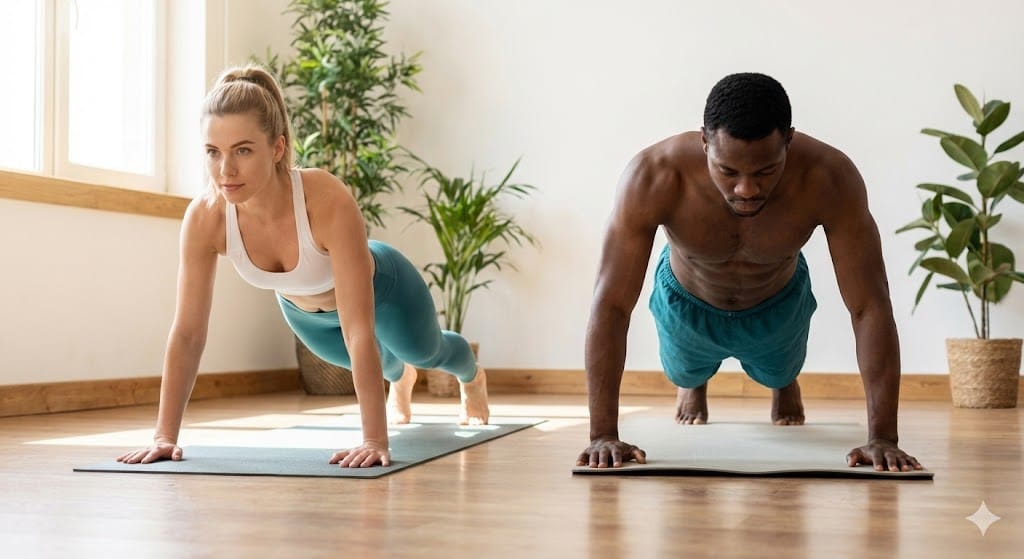
When you first started training, fifteen minutes of bodyweight exercise probably left you breathing hard and reaching for water. After several weeks of consistent home workouts, that same session feels significantly less taxing. It’s not because you’ve gone soft. It’s because your cardiovascular system has adapted. Your heart pumps more blood per beat, and your muscles extract oxygen more efficiently. Your body also becomes far better at managing the metabolic demands of exercise.
Track endurance improvements by noting:
- How long you can exercise before feeling genuinely breathless
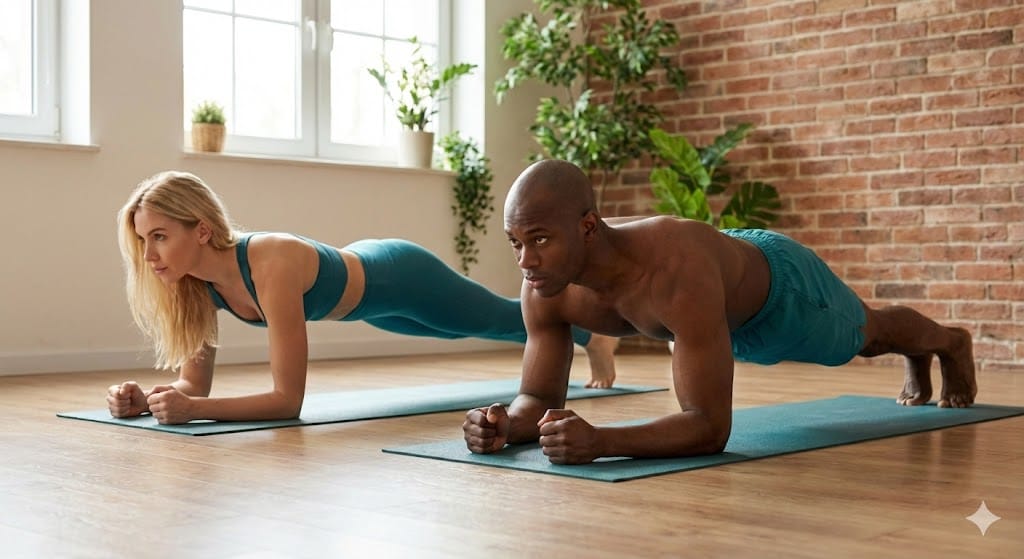
- How long your plank hold lasts (from 10 seconds to 30 to 60 is a massive cardiovascular and muscular endurance win)
- How quickly your heart rate returns to baseline after an intense set
- How many rounds of a circuit you can complete before needing an extended break
- How you feel climbing stairs, carrying groceries, or chasing kids around — because functional fitness improvement shows up in real life first
Sign 3: Progress Photos Track Fitness Progress Without a Scale
Progress photos are one of the most powerful tools available for tracking fitness progress without a scale. They’re also one of the most underused, because they require vulnerability. But compare a photo taken eight weeks apart under consistent conditions, and you often see real changes. They’re genuinely invisible in the mirror, because you see yourself every day and adjust to gradual shifts. And they’re completely missed by the scale.
How to take effective progress photos:
- Use the same location, lighting, and time of day for every photo — consistency is everything.
- Take photos from the front, side, and back to capture all angles where body composition changes occur.
- Wear the same fitted clothing (or minimal clothing) each time so changes in body shape are visible rather than hidden by baggy tops.
- Take photos every 4 weeks rather than every week — changes over shorter intervals are often too subtle to see and can demotivate you unnecessarily.
- Don’t share the photos if that feels uncomfortable — they’re for your eyes only. The value is in the comparison, not the performance.
Sign 4: Your Body Measurements Are Changing
A fabric measuring tape costs almost nothing and tells you far more than a scale. Because body measurements track changes in specific areas — waist, hips, chest, arms, thighs — they directly capture the body composition shifts that the scale obscures. Changes in waist circumference are particularly meaningful from a health perspective. Research consistently links reductions in waist measurement, and the visceral fat that goes with it, to better metabolic health, lower cardiovascular risk, and improved insulin sensitivity.
Key measurements to track:
- Waist (at the narrowest point, or at the navel)
- Hips (at the widest point)
- Chest (at the fullest point)
- Upper arms (mid-bicep, flexed and relaxed)
- Thighs (mid-thigh, both legs)
Measure every 4 weeks, at the same time of day (morning is typically most consistent), and track the numbers in a simple notebook or phone note. Additionally, calculate your waist-to-hip ratio — a waist circumference that’s consistently shrinking relative to your hips is a genuinely significant health and fitness marker.
Sign 5: Your Clothes Fit Differently
Your wardrobe is a remarkably honest fitness tracker — and it requires no measurement at all. Maybe jeans feel looser through the waist but fit better through the glutes. Maybe shirts feel snug across the shoulders in a way they didn’t before. Or maybe you reach for a smaller size without really thinking about it. Those are tangible, real-world signs that your body composition is shifting in the right direction. Clothing fit responds to volume changes in your body: fat loss, muscle gain, reduced bloating from a better diet. It reflects those shifts rather than weight changes, which makes it a much more visually meaningful metric.
Sign 6: Your Energy, Mood, and Sleep Are Improving
This is perhaps the most underappreciated sign on this list — and arguably the one that matters most for quality of life. Consistent exercise has well-documented positive effects on energy levels, mood, cognitive function, and sleep quality. These changes often appear within the first two to four weeks of regular training. Because they happen gradually, it’s easy to miss them unless you’re specifically paying attention.
Watch for these markers of improving fitness and health:
- You wake up feeling more rested, even without sleeping longer
- That 3pm energy slump isn’t hitting as hard as it used to
- You feel more emotionally resilient — exercise is one of the most effective natural mood regulators known to science
- Your concentration and mental clarity improve, particularly in the hours after a workout
- Anxiety and stress feel more manageable — because vigorous physical activity genuinely metabolizes stress hormones like cortisol
- You feel better in your body in a general, hard-to-articulate way that goes beyond any specific measurement
These benefits are real, they’re measurable (sleep tracking apps, mood journaling, and energy ratings work well here), and they represent meaningful fitness progress — regardless of what the scale says.
Sign 7: Everyday Life Is Getting Physically Easier
This is the ultimate real-world fitness test — and it’s one that matters far beyond the gym or your living room floor. Fitness isn’t an end in itself; it’s a tool for living better. Therefore, when daily activities that used to feel effortful start feeling genuinely easy, that’s the fitness payoff expressing itself where it actually counts.
Signs that your functional fitness is improving:
- Carrying groceries up multiple flights of stairs without needing to rest
- Playing with children or younger siblings without getting winded quickly
- Sitting at a desk for extended periods with less back and hip discomfort
- Getting up and down from the floor more easily and with better balance
- Completing physically demanding activities (hiking, gardening, moving furniture) with noticeably more capacity than before
- Moving through your environment with more confidence and ease
These improvements represent genuine gains in functional strength, mobility, and cardiovascular capacity — and no scale reading can capture any of them.
How to Track Fitness Progress Without a Scale: Build Your Own System
Now that you know what to look for, let’s talk about how to actually track it — because progress that isn’t recorded has a way of being forgotten or discounted, especially during difficult patches when motivation is lower. A simple, consistent tracking system transforms vague feelings of “I think I’m improving” into concrete, visible evidence that you can return to whenever doubt creeps in.
A Simple Journal to Track Fitness Progress Without a Scale
A workout journal doesn’t need to be complicated. A notebook or a basic phone note works perfectly — the key is tracking the same data consistently so you can compare across time. After each session, record:
- The date and duration of your workout
- Which exercises you performed and at what variation (e.g., “incline push-ups, not knee push-ups today”)
- Sets and reps completed (e.g., “3 sets × 10 reps”)
- Brief notes on how the session felt — energy level, difficulty, anything notable
- Any personal bests (new rep record, longer plank, first time completing a harder variation)
Looking back through a journal after 8 weeks and seeing the progression from “wall push-ups, 3 × 8 reps, felt hard” to “knee push-ups, 3 × 12 reps, felt easy” is genuinely motivating in a way that no scale reading could ever replicate. Furthermore, it provides objective data during periods when you’re feeling discouraged — because the numbers don’t lie, even when your perception does.
Track Habits, Not Just Workouts
Because consistency is the true engine of fitness progress, tracking the habits that create consistency is just as valuable as tracking the workouts themselves. A simple daily habit tracker reinforces the behavioral patterns that produce results. It can be a checkbox in a journal, a sticker chart, or a phone app. Consider tracking:
- ✅ Workout completed
- ✅ Hydration goal met (e.g., 2L of water)
- ✅ Sleep target hit (7–9 hours)
- ✅ Protein-rich meal eaten
- ✅ Recovery day honored (no skipping rest days)
Each completed checkbox is a vote cast for the healthier, stronger version of yourself you’re building. Habit tracking also makes it easy to identify patterns. You might notice that your worst workout weeks always correlate with poor sleep, or that your best weeks correlate with consistent meal prep. That kind of insight is invaluable.
Set SMART Performance Goals
Vague goals (“I want to get fitter”) are essentially unmeasurable — and unmeasurable goals produce no feedback about whether you’re succeeding. Therefore, translate your intentions into specific, measurable targets that give you something concrete to work toward and celebrate when you hit them. Examples of SMART fitness goals:
- Complete three home workouts every week for the next four weeks
- Hold a plank for 60 consecutive seconds by the end of the month
- Perform 10 full push-ups without stopping by week eight
- Complete the Sanook Fit 30-Day Beginner Challenge without missing a session
- Walk 8,000 steps five days per week
Performance goals like these keep your training purposeful and forward-focused — and because they’re entirely within your control (unlike scale measurements, which can be affected by dozens of external factors), hitting them feels genuinely earned. Want goal-hitting to feel consistent rather than accidental? Our guide on the science behind fitness habits is an excellent companion read.
Common Mistakes to Avoid When You Track Fitness Progress Without a Scale
Even with the right metrics in place, certain habits around tracking can undermine your confidence and momentum. Here are the most common pitfalls — and how to sidestep them entirely.
Checking Too Frequently to Track Fitness Progress Without a Scale
Daily weigh-ins, weekly body measurements, constant photo comparisons — all of these produce more noise than signal. Meaningful physical change unfolds over weeks and months, not days. Therefore, schedule your progress checks on a calendar: measurements every 4 weeks, progress photos every 4–6 weeks. Then step away and focus on showing up and training well in the meantime.
Comparing Yourself to Other People
Your body responds to training differently from anyone else’s. Your genetics, starting point, age, sleep quality, stress levels, nutrition, and dozens of other factors are entirely unique to you. Comparing your week-four progress to someone else’s week-twelve transformation photo isn’t just unfair — it’s genuinely meaningless. The only valid comparison is you versus you. Therefore, look at your own before-and-after, your own rep counts, your own energy levels. That’s where real progress lives.
Ignoring Non-Physical Progress
Strength, endurance, sleep quality, energy, mood, confidence — these are real, meaningful outcomes of consistent training. And they often arrive before the visible physical changes do. Furthermore, they’re often the changes that most profoundly improve your quality of life. Don’t discount them because they can’t be captured in a photo or measured in centimetres. They count. Track them deliberately, celebrate them enthusiastically.
Expecting Linear Progress
Fitness progress is rarely a smooth upward curve. Most people experience periods of rapid improvement followed by apparent plateaus — and those plateaus can feel devastating if you’re only tracking one or two metrics. However, plateaus are almost always temporary, and they often precede a breakthrough. Because your body is adapting on many levels simultaneously, the metric you’re watching might stall while five other metrics continue improving. A broader tracking system means you always have evidence of progress, even when one area feels stuck.
FAQ: How to Track Fitness Progress Without a Scale
How often should I weigh myself if I do use a scale?
If you choose to include body weight in your tracking toolkit, weigh in once per week under identical conditions: same day, same time, same clothing. That gives a more useful trend line than daily measurements. However, even weekly data contains a lot of noise due to hydration fluctuations and other variables. Therefore, look at a rolling 4-week average rather than any individual reading. And whenever the scale contradicts the evidence from your other metrics — strength improvements, better-fitting clothes, increased energy — trust the broader picture.
I look different but the scale hasn’t moved. What’s happening?
This is one of the most common and confusing experiences in home fitness — and it almost always means something genuinely positive. As you train consistently, your body simultaneously loses fat and builds muscle tissue. Muscle is denser than fat, so it takes up less space for the same mass. Your body can become visibly smaller, leaner, and more defined while the scale stays essentially flat. This is body recomposition — and it’s exactly what you want to be happening. It means your training is working perfectly.
How long before I see real results?
This varies considerably based on training frequency, intensity, nutrition, sleep, and individual genetics. However, as a broad guideline: most people notice strength and endurance improvements within 2–3 weeks of consistent training. Visible body composition changes typically become clear to others around weeks 6–8 (though you’ll often see them in photos earlier). Significant structural changes in muscle size and overall fitness typically require 3–6 months of consistent, progressive training. Therefore, the best thing you can do is commit to the process, track non-scale metrics from week one, and let the visible changes be a pleasant surprise rather than your primary motivator.
Your Progress Is Bigger Than a Number
Here’s the shift that changes everything: when you learn to track fitness progress without a scale, you stop measuring yourself against an arbitrary, context-free number — and you start measuring yourself against what you could actually do before. That reframe is enormously powerful. Because suddenly, every additional push-up rep is evidence. Every longer plank is proof. Every flight of stairs that leaves you less breathless than last month is data.
Your body is changing. Fitness is improving. And your life is getting better in real, tangible ways that no single number could ever capture. The Sanook Fit approach has always been about building genuine, sustainable fitness — not chasing a scale reading — and these seven signs are your compass for knowing, with complete certainty, that you’re moving in the right direction.
For your complete training plan, explore our Bodyweight Training for Beginners guide and our Bodyweight Progression Guide for 2026. And whenever you need a reminder of how far you’ve come, flip back through your workout journal — because the numbers in there tell a story the scale never could.
Follow Sanook Fit on YouTube, Instagram, TikTok, and Facebook for workouts, progress tips, and the community you need to keep showing up — one rep, one day, one breakthrough at a time.