When people ask how many sets per exercise they need, the short answer is this: for most people, 2 to 4 sets per exercise is enough to build strength, improve fitness, and support muscle growth, especially when you combine it with good technique and progressive overload. Beginners, meanwhile, often do well with just 1 to 2 sets. More experienced exercisers, on the other hand, may benefit from 3 to 5 sets, depending on their goals, recovery, and workout intensity.
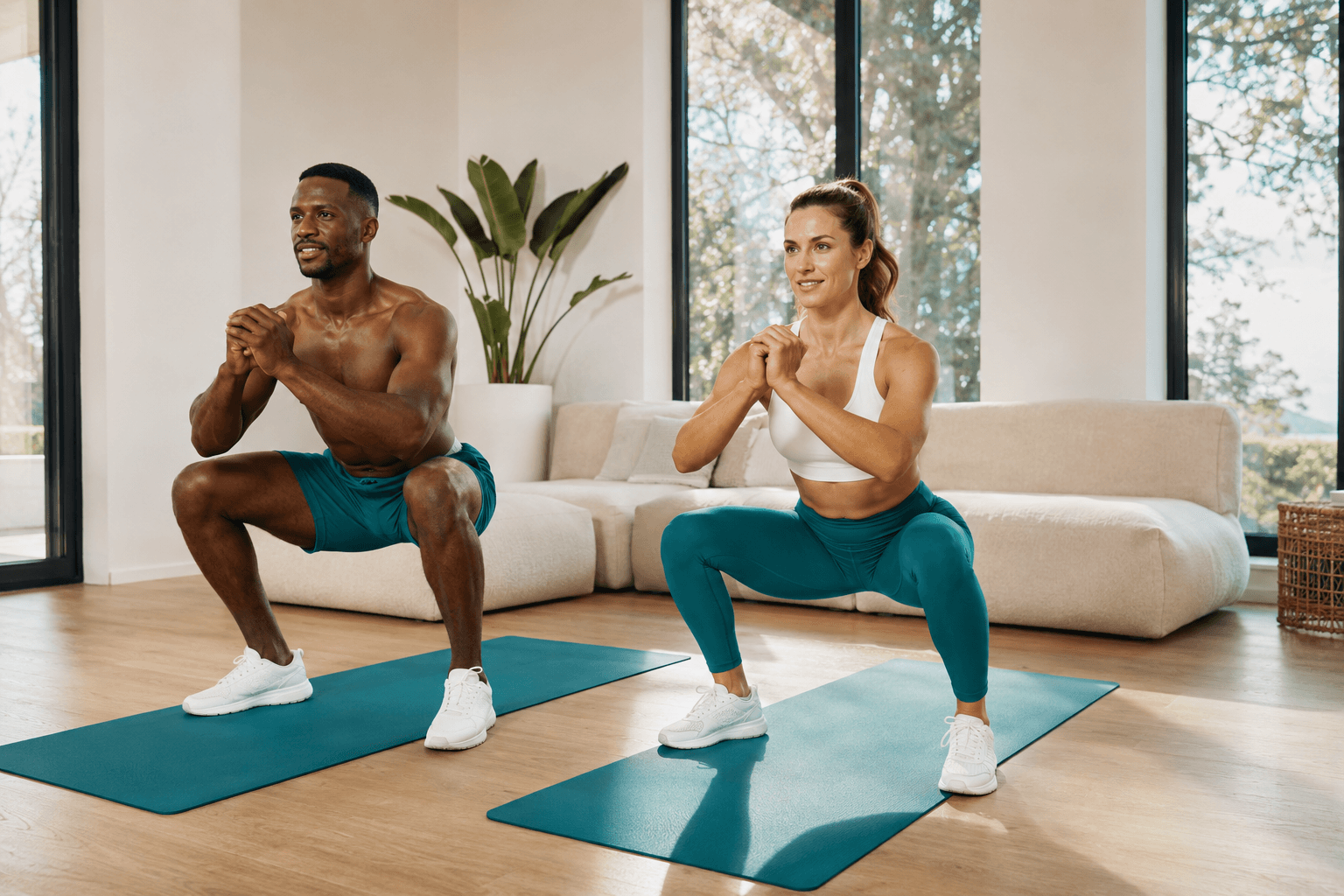
How Many Sets Per Exercise: More Isn’t Always Better
First, imagine two people doing push-ups. The first person performs 10 perfect push-ups for 3 quality sets. The second person, however, rushes through 10 push-ups for 10 sloppy sets, using poor technique and barely resting between them. So, who actually gets the better workout?
Many people assume it is the second person. In reality, though, the answer is usually the first. After all, fitness isn’t simply about doing more—rather, it’s about doing enough. In fact, one of the biggest mistakes beginners make is believing that endless sets automatically produce faster results. Unfortunately, the body doesn’t work that way.
What Is a Set?
Let’s start with the basics. A set is simply a group of repetitions performed back to back before you rest. For example, you might do 10 squats, rest, do 10 more, rest again, and then finish with a final 10. Altogether, that equals 3 sets of 10 repetitions. The idea sounds simple, yet this small concept has a huge impact on your results.
Sets vs Repetitions
Often, people confuse these two terms, so here is the difference. A repetition (or rep) is one complete movement, such as a single push-up, squat, or lunge. A set, meanwhile, is a group of those repetitions performed together. Therefore, if you complete 15 squats, rest, do 15 more, rest, and finish with another 15, you have completed 3 sets of 15 repetitions. Once you understand this difference, following any workout plan becomes much easier.
Why Sets Matter
Indeed, every time you exercise, your body receives a signal to adapt and grow stronger. However, that signal depends on the right amount of work rather than the highest possible amount. Because everyone responds differently, generic advice can sometimes mislead you. Throughout this guide, therefore, you’ll learn exactly how to adjust your training volume for your own goals.
The Sanook Philosophy
At Sanook Fit, we believe workouts should be effective, enjoyable, and sustainable—not unnecessarily complicated, excessively long, or designed to leave you exhausted every single day. Instead, smart training means doing enough work to improve while still saving enough energy to come back tomorrow. That, ultimately, is how lasting habits are built and how fitness sticks for the long term.
What You’ll Learn in This Guide
By the time you finish this guide on how many sets per exercise you should do, you’ll understand the following:
- How many sets beginners really need
- Whether 3 sets are actually enough
- How many sets support muscle growth
- How to adjust sets for fat loss
- How to train for strength and endurance
- When adding more sets helps—and when it actually hurts progress
- How to structure bodyweight workouts for the best long-term results
Most importantly, you’ll know exactly how many sets per exercise suit your goals and understand why these recommendations work, so you can apply them with confidence.
Sanook Fit Coach’s Tip 💡 Don’t judge a workout by how many sets you completed. Instead, judge it by how well you completed them. Three focused sets with good technique will almost always outperform six rushed sets done on autopilot. Quality, in other words, creates results—while quantity only helps once quality comes first.
So, How Many Sets Per Exercise Should You Actually Do?
If you’re hoping for one magic number that works for everyone, you’ll probably feel disappointed, because there simply isn’t one. Instead, the ideal number of sets depends on several factors, including:
- Your fitness level
- Your training goal
- The exercise you’re performing
- How challenging each set feels
- Your recovery
- How often you train
That’s exactly why two people following the same workout might need different amounts of training volume. The good news, however, is that a few evidence-informed guidelines work extremely well for almost everyone.
The Sanook Fit Rule
Rather than asking, “How many sets should I do?” try asking instead, “How many quality sets can I perform with excellent technique?” That simple change shifts your focus from quantity to quality—and that, ultimately, is where better results begin.
How Many Sets Per Exercise for Beginners?
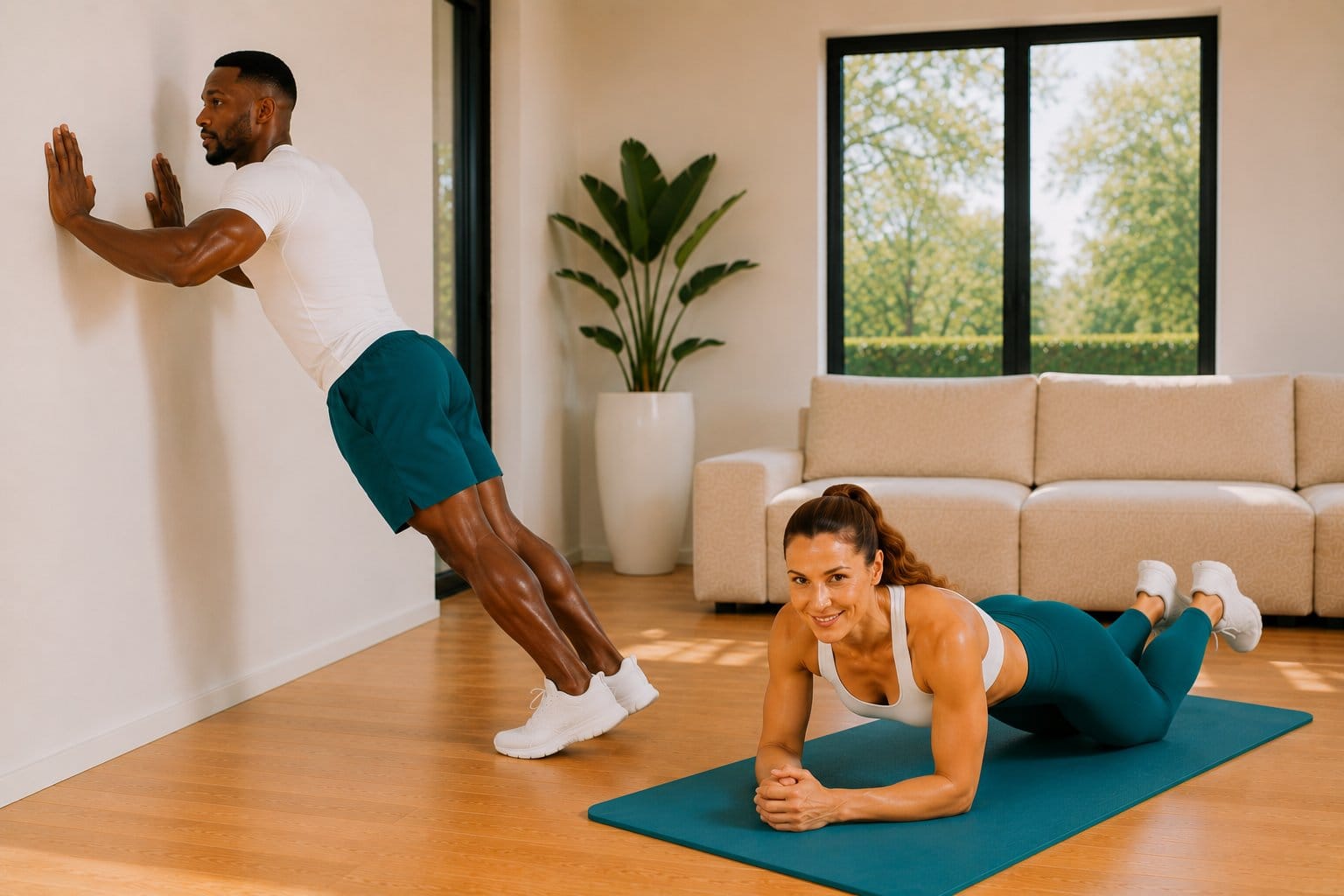
So how many sets per exercise should a beginner do? If you’re new to exercise, you really don’t need marathon workouts. Right now, your body is already adapting to new movement patterns, increased activity, better coordination, and higher training loads. As a result, even a small amount of quality work can produce impressive results.
Recommended: 1 to 2 sets per exercise. Generally, this is enough to build strength, learn technique, improve fitness, boost confidence, and avoid excessive soreness. During these early stages, more simply isn’t necessary—consistency, on the other hand, matters far more. For a complete starting point, our guide to building muscle without weights pairs perfectly with these set ranges.
Example Beginner Workout
| Exercise | Sets | Reps |
|---|---|---|
| Chair Squats | 2 | 10–12 |
| Wall Push-Ups | 2 | 8–10 |
| Glute Bridges | 2 | 12 |
| Bird Dogs | 2 | 10 each side |
| Standing Mountain Climbers | 2 | 20 seconds |
How Many Sets Per Exercise for Intermediate Exercisers?
Once your body adapts, you’ll likely need slightly more volume to keep progressing. Even so, you shouldn’t simply pile on endless sets. Instead, consider raising the challenge in smarter ways, such as harder exercise variations, shorter rest periods, or more advanced progressions. In most cases, increasing difficulty proves far more effective than endlessly adding sets.
How Many Sets Per Exercise for Muscle Growth?
When deciding how many sets per exercise builds muscle, remember that it isn’t about doing hundreds of repetitions. Rather, it’s about creating enough challenge for your muscles to adapt. For most bodyweight exercises, therefore, 3 to 5 quality sets tends to work well. Ideally, choose a variation that brings you reasonably close to muscular fatigue while you still maintain excellent technique. Good options include decline push-ups, Bulgarian split squats, single-leg glute bridges, and pike push-ups. Then, as each exercise becomes easier, increase the challenge rather than simply piling on more sets.
How Many Sets Per Exercise for Strength?
Meanwhile, strength training focuses on producing high levels of force. Consequently, that often means harder exercise variations, fewer repetitions, and longer rest periods. For this goal, aim for roughly 3 to 6 sets. Great examples include archer push-ups, pistol squats, handstand push-up progressions, and single-leg squats. Above all, every repetition should stay controlled and deliberate. If you want to push further, our advanced bodyweight training guide shows how to keep progressing without any weights.
How Many Sets Per Exercise for Fat Loss?
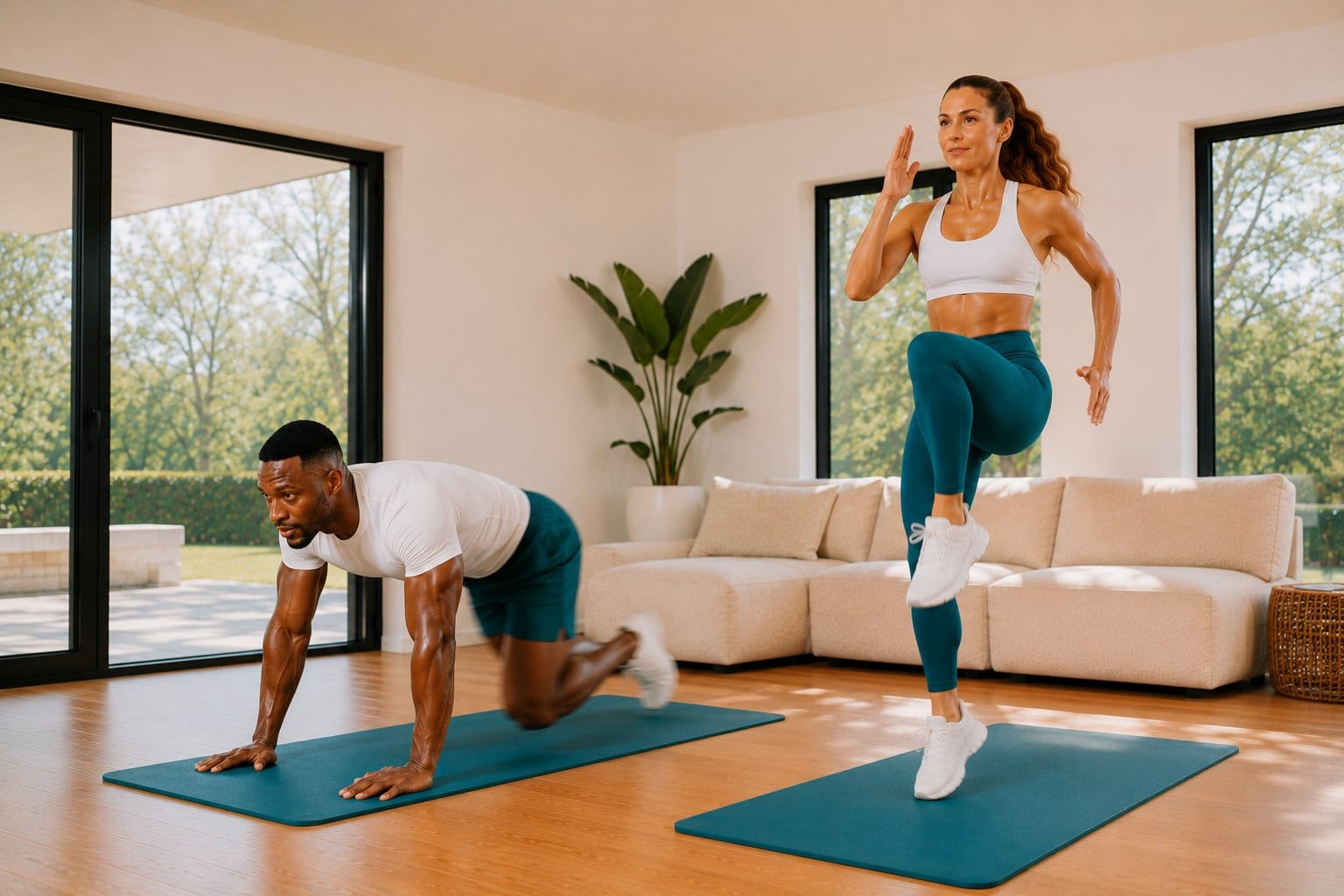
Here’s a common misconception worth clearing up. Fat loss doesn’t come from performing endless sets. Instead, it primarily depends on maintaining an appropriate calorie balance while you preserve muscle through resistance training. Exercise then supports that process by increasing energy expenditure and helping you hold onto lean muscle mass. For most people, therefore, 2 to 4 sets works nicely. Just combine them with full-body exercises, short rest periods, consistent activity, and balanced nutrition. In short, the answer to how many sets per exercise burns fat isn’t 50 sets—you need consistency. For a ready-made plan, explore our bodyweight workout for weight loss.
How Many Sets Per Exercise for Endurance?
Similarly, muscular endurance focuses on your ability to keep working over longer periods. So how many sets per exercise build endurance? Usually, fewer than you might expect. For that reason, 2 to 4 sets usually does the job, typically using moderate to higher repetitions, shorter rest intervals, and continuous movement. Suitable exercises include squats, lunges, step-ups, and mountain climbers.
How Many Sets Per Exercise: Goal-Based Recommendations
Here’s a quick overview so you can see how the numbers compare side by side.
| Goal | Sets per Exercise | Focus |
|---|---|---|
| General Fitness | 2–3 | Consistency and technique |
| Beginners | 1–2 | Learning movement patterns |
| Muscle Growth | 3–5 | Progressive overload |
| Strength | 3–6 | Hard exercise variations |
| Fat Loss | 2–4 | Full-body training and consistency |
| Muscular Endurance | 2–4 | Sustained effort and shorter rests |
Notice a pattern? When you ask how many sets per exercise you need, almost every recommendation falls between 2 and 4 sets. In other words, very few people truly need ten sets of the same exercise.
Does Difficulty Change How Many Sets Per Exercise You Need?
Absolutely, it does. Compare two exercises, for instance. With wall push-ups, most people can comfortably perform more sets, because the movement stays relatively easy. With archer push-ups, by contrast, you demand much greater strength and stability, so two or three high-quality sets may be plenty. As a rule, then, the harder the exercise becomes, the less total volume you usually need.
Full-Body vs Split Workouts
Naturally, your workout structure also affects the number of sets. With full-body workouts, since you train multiple muscle groups in one session, 2 to 3 sets per exercise is often enough. This approach works especially well for beginners, busy people, general fitness, and fat loss. With split workouts, however, you dedicate an entire session to one area, such as the upper body or legs. In that case, you may perform 3 to 5 sets per exercise, simply because you’re concentrating on fewer muscle groups. Our upper body workout and no-equipment leg workout both show this split approach in action.
How Many Sets Per Exercise Across a Week?
Even so, many people obsess over how many sets they perform in a single session. However, a better question is this: how many quality sets am I completing across the whole week? For example, you might do 3 sets of push-ups on Monday, 3 more on Thursday, and another 3 on Saturday. Altogether, that’s 9 quality sets for your pushing muscles across the week. Frequently, that proves far more meaningful than cramming everything into one exhausting workout.
More Isn’t Always Better
Picture two workouts side by side. In Workout A, you complete 3 excellent sets with perfect technique, controlled movement, and good recovery. In Workout B, meanwhile, you grind through 8 rushed sets with poor technique, little recovery, and sloppy repetitions. So which approach to how many sets per exercise builds more long-term strength? Almost always, it’s Workout A. Quality, after all, creates adaptation—whereas excessive fatigue often reduces it.
The Sanook Volume Formula
When you’re deciding how many sets to perform, simply ask yourself four quick questions:
- ✅ Is my technique still excellent?
- ✅ Am I genuinely challenging myself?
- ✅ Am I recovering well?
- ✅ Can I repeat this consistently next week?
If you can answer “yes” to all four, then you’re probably training at an appropriate volume.
Sanook Fit Coach’s Tip 💡 Don’t add more sets simply because today’s workout felt comfortable. First, ask whether you could increase the difficulty instead. For example, progressing from knee push-ups to standard push-ups often produces better results than adding three extra sets of knee push-ups. So train smarter before you train longer.
How Many Sets Per Exercise in Practice
Understanding training volume is one thing, yet using it effectively is something else entirely. So let’s apply everything you’ve learned to real Sanook Fit workouts. By the end of this section, you’ll know exactly how many sets to perform for the most common bodyweight exercises—and, more importantly, when it’s time to raise the challenge.
Push-Ups
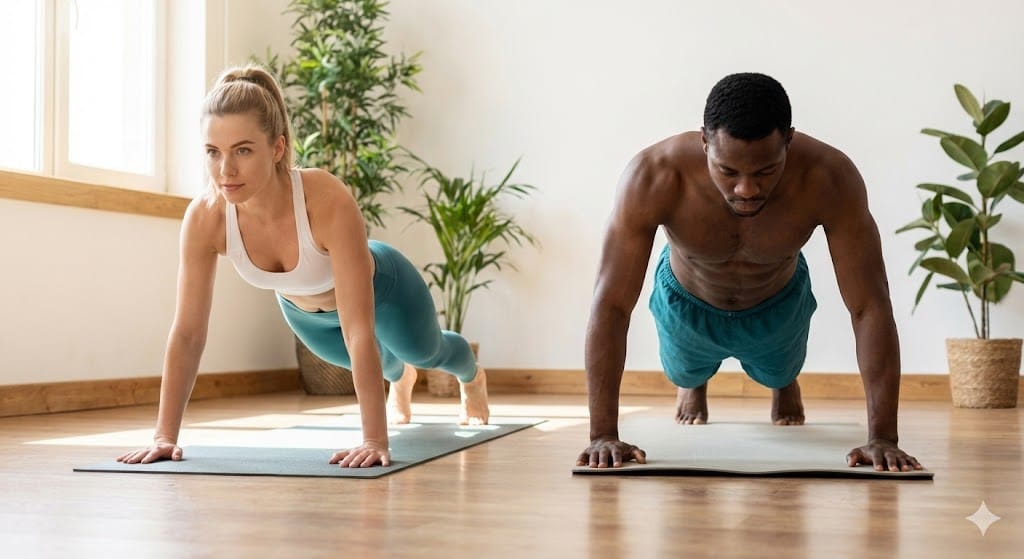
To begin with, push-ups develop the chest, shoulders, triceps, and core all at once. Naturally, the right number of sets depends on the variation you’re using.
- Beginner: Wall Push-Ups — 2 sets, 8–12 reps
- Intermediate: Standard Push-Ups — 3 sets, 8–15 reps
- Advanced: Decline or Archer Push-Ups — 4 sets, 6–10 reps
Because these variations grow more demanding, you really don’t need endless sets—so focus on quality instead. Generally, you’re ready for a harder variation once your final repetitions remain controlled, every set still looks excellent, and you recover comfortably before your next workout. At that point, rather than adding more sets, simply progress to a more challenging push-up.
Squats
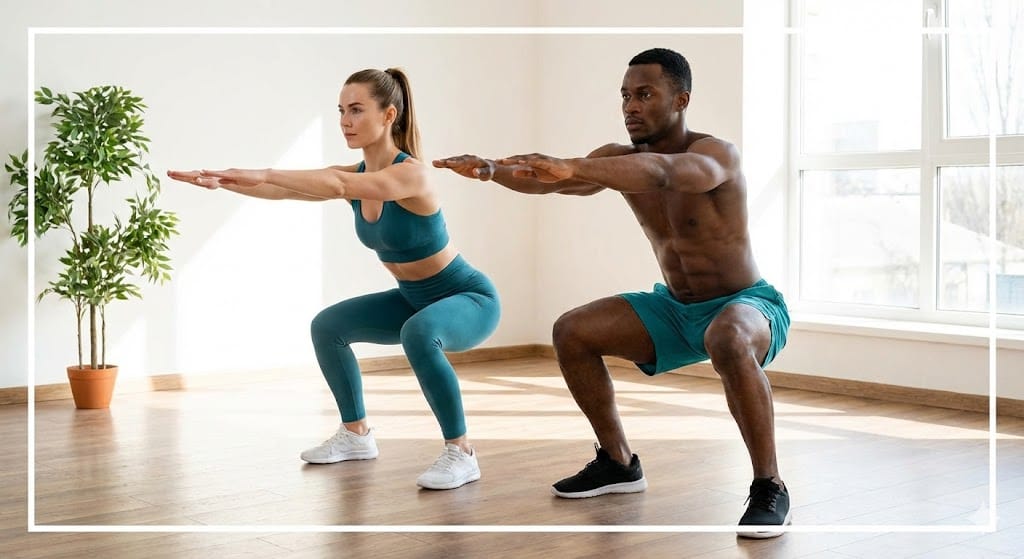
Likewise, squats rank among the most effective lower-body exercises available. As with push-ups, the right volume depends on the variation:
- Beginner: Chair Squats — 2 sets, 10–12 reps
- Intermediate: Bodyweight Squats — 3 sets, 12–15 reps
- Advanced: Pistol Squat Progressions — 3–4 sets, 5–8 reps each leg
Since single-leg exercises create significantly more demand, fewer repetitions and sets are often enough.
Lunges
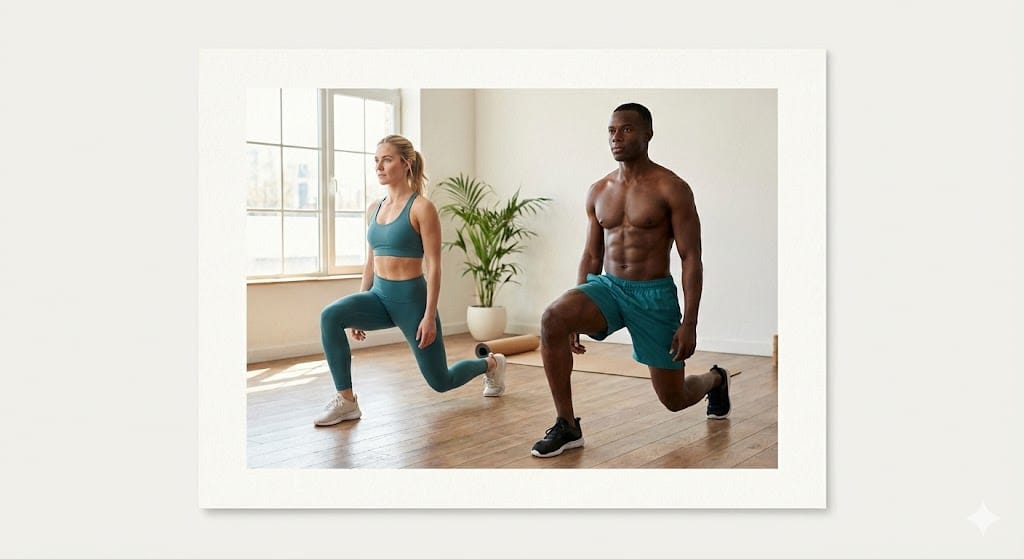
Next, lunges improve balance, hip stability, leg strength, and coordination together. Here’s how the variations stack up:
- Beginner: Supported Reverse Lunges — 2 sets, 8 reps per leg
- Intermediate: Reverse Lunges — 3 sets, 10–12 reps per leg
- Advanced: Jumping Lunges — 3–4 sets, 8–12 reps per leg
Throughout each set, quality landings matter more than maximum repetitions.
Planks
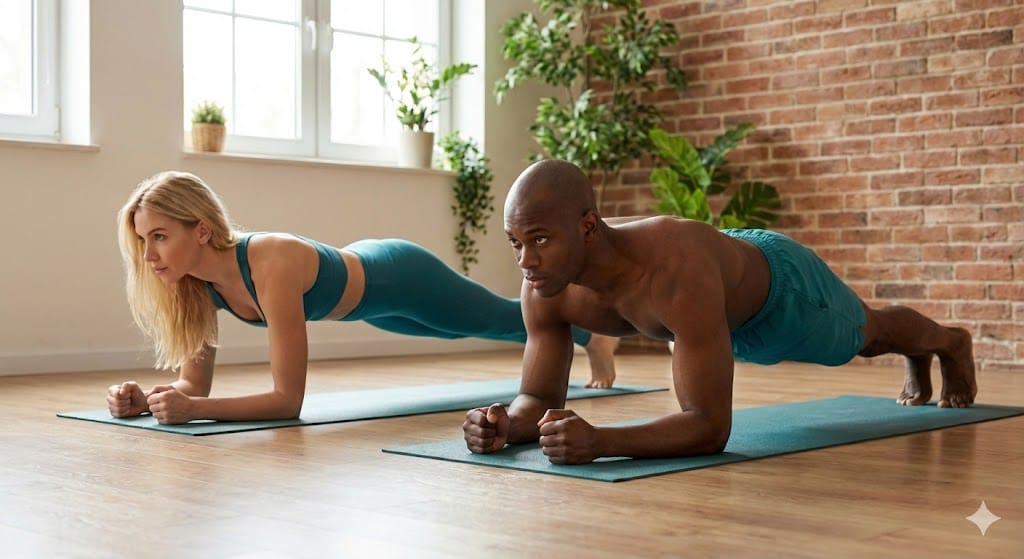
Unlike many exercises, planks are usually measured by time rather than reps:
- Beginner: Knee Plank — 2 sets, 20–30 seconds
- Intermediate: Forearm Plank — 3 sets, 30–45 seconds
- Advanced: Shoulder Tap Plank — 3–4 sets, 45–60 seconds
However, if your hips begin to rotate too much, simply finish the set, because good form always comes first. For more core ideas, see our bodyweight workouts for abs.
Mountain Climbers
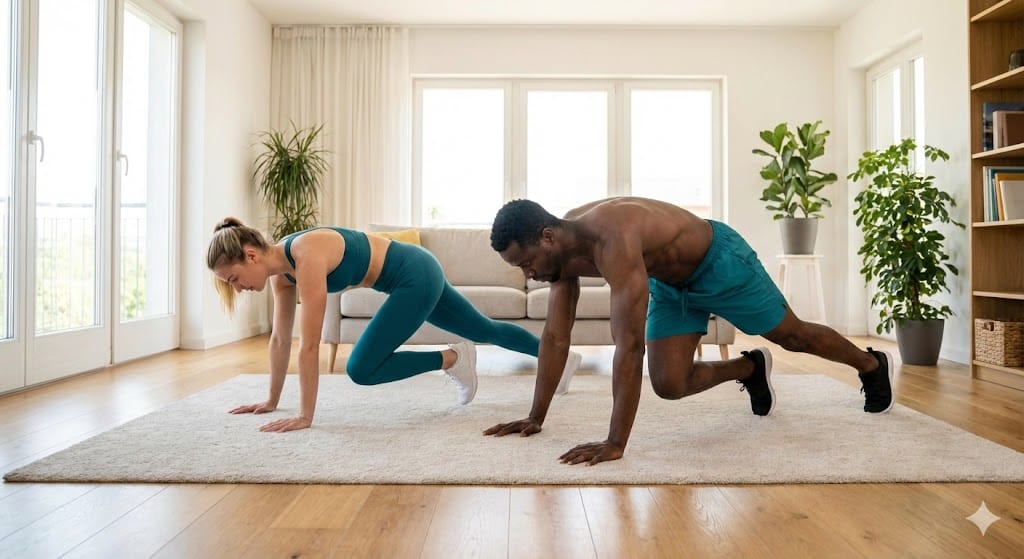
Similarly, mountain climbers combine cardio, core, and shoulder stability in one move:
- Beginner: Standing Mountain Climbers — 2 sets, 20 seconds
- Intermediate: Standard Mountain Climbers — 3 sets, 30 seconds
- Advanced: Cross-Body Mountain Climbers — 4 sets, 40 seconds
Even so, speed should never replace control.
Burpees
Finally, burpees challenge almost every major muscle group. Because they’re so demanding, however, more isn’t always better:
- Beginner: Step-Back Burpees — 2 sets, 6–8 reps
- Intermediate: Standard Burpees — 3 sets, 8–12 reps
- Advanced: Burpees with Push-Up — 3–4 sets, 10–15 reps
Throughout each set, focus on smooth movement rather than rushing through repetitions.
Sample Sanook Fit Workouts
Beginner Full-Body Workout
| Exercise | Sets | Reps |
|---|---|---|
| Chair Squat | 2 | 10–12 |
| Wall Push-Up | 2 | 8–10 |
| Glute Bridge | 2 | 12 |
| Standing Mountain Climber | 2 | 20 sec |
| Knee Plank | 2 | 20 sec |
Intermediate Workout
| Exercise | Sets | Reps |
|---|---|---|
| Squat | 3 | 15 |
| Push-Up | 3 | 12 |
| Reverse Lunge | 3 | 10 each leg |
| Plank | 3 | 40 sec |
| Burpee | 3 | 10 |
Advanced Workout
| Exercise | Sets | Reps |
|---|---|---|
| Pistol Squat Progression | 4 | 6 each leg |
| Archer Push-Up | 4 | 8 |
| Jumping Lunge | 4 | 10 each leg |
| Shoulder Tap Plank | 4 | 60 sec |
| Burpee with Push-Up | 4 | 12 |
Progressive Overload Without Weights
Meanwhile, one of the biggest myths about bodyweight training is that you eventually stop improving. In truth, however, that only happens if your workouts never change. So here are five reliable ways to keep progressing without any equipment.
- Increase repetitions. For example, move from 10 push-ups in week one, to 12 in week two, and then to 15 in week three.
- Add a set. You might progress from 2 sets to 3, but only once your current workload feels comfortable.
- Choose a harder variation. For instance, advance from wall push-ups, to counter push-ups, then knee push-ups, and finally standard push-ups. Frequently, this is the best option for bodyweight training.
- Slow down the movement. A slower lowering phase increases time under tension. So lower over 3 seconds, pause briefly, and then push back up—no extra equipment required.
- Reduce rest time. Gradually shorten rest from 60 seconds, to 45, and then to 30. Naturally, shorter recovery raises the challenge, especially in endurance-focused workouts.
Common Set Mistakes That Reduce Results
Many people perform more work without ever making more progress. Here, then, is why that happens.
- Adding sets too soon. More sets aren’t automatically better, so master your current training volume first.
- Ignoring recovery. Because every additional set increases recovery demands, doing less can actually help you improve faster when you feel constantly sore or tired.
- Using poor technique. Five sloppy sets rarely outperform three excellent ones, so technique should always improve before volume does.
- Doing the same workout forever. Eventually, your body adapts. Therefore, if you’ve repeated the same exercises, reps, and sets for months, change something.
- Chasing exhaustion. Feeling wiped out isn’t proof of an effective workout, since progress comes from appropriate training rather than complete exhaustion.
Want to bust a few more training myths? Our 15 bodyweight training myths debunked covers the most common ones in detail.
How Do You Know It’s Time to Add Another Set?
Before you increase your volume, ask yourself these four questions:
- ✔ Am I finishing every set comfortably?
- ✔ Is my technique still excellent?
- ✔ Am I recovering well between workouts?
- ✔ Have I stopped making progress?
If the answer is yes, then a small increase in training volume may help. Otherwise, simply stay where you are, because there’s no prize for progressing too quickly.
The Sanook Volume Ladder
Think of progression like climbing stairs, one step at a time:
- Learn the movement
- Master the movement
- Increase repetitions
- Increase exercise difficulty
- Only then, consider adding more sets
Following this order helps you maximise progress while reducing unnecessary fatigue.
Sanook Fit Coach’s Tip 💡 Before adding another set, ask one simple question: “Have I truly mastered my current workout?” Often, improving your technique, slowing your repetitions, or progressing to a harder variation will produce better results than simply doing more work. So train with purpose, not just volume.
How Many Sets Per Exercise: Frequently Asked Questions
How many sets per exercise should I do?
When clients ask how many sets per exercise they should do, we usually say this: for most people, 2 to 4 quality sets per exercise makes an effective starting point. Ultimately, how many sets per exercise you need depends on your fitness level, your training goals, exercise difficulty, recovery, and overall weekly training volume. Above all, focus on performing each set with excellent technique rather than simply doing more.
Is 3 sets per exercise enough?
Yes, generally it is. When people ask how many sets per exercise are enough, the honest answer is that for many beginners and intermediate exercisers, 3 well-executed sets provide enough stimulus to improve strength, build muscle, and enhance fitness. However, if your progress slows over time, then increasing exercise difficulty often helps more than simply adding sets.
Are 5 sets per exercise too much?
Not necessarily, in fact. In fact, five sets can suit advanced athletes, challenging compound exercises, and strength-focused programs. Even so, more sets only help when you can maintain good technique and recover adequately between workouts.
How many sets per exercise should beginners do?
Indeed, many beginners make excellent progress with just 1 to 2 sets per exercise. Then, as technique, strength, and confidence improve, moving up to 3 sets often becomes appropriate. Either way, there’s no need to rush.
How many sets per exercise for fat loss?
Generally, for most bodyweight workouts, 2 to 4 sets per exercise is enough. Remember, fat loss depends primarily on overall energy balance, while resistance training helps preserve muscle and improve body composition. Therefore, consistency matters far more than excessive workout volume.
Should I add reps or sets per exercise first?
In most cases, increase your repetitions first. After that, progress to a more challenging exercise variation. Finally, only increase sets once those options no longer provide enough of a challenge.
Can I do too many sets per exercise?
Yes, unfortunately, you can. Excessive training volume may lead to poor recovery, increased fatigue, reduced workout quality, plateaued progress, and even greater injury risk. After all, your body improves during recovery—not while accumulating endless sets.
How Many Sets Per Exercise: Myth vs Reality
Finally, let’s separate a few common misconceptions from evidence-based practice.
| Myth | Reality |
|---|---|
| More sets always build more muscle. | More isn’t always better; appropriate training volume matters most. |
| Everyone should perform three sets. | The ideal number varies according to goals and experience. |
| Beginners should train until exhaustion. | Beginners often progress well with fewer, high-quality sets. |
| Long workouts are always better. | Efficient workouts done consistently often produce better results. |
| If you’re not sore, your workout wasn’t effective. | Soreness is not a reliable measure of progress. |
| Advanced athletes always need more sets. | Harder variations often reduce the need for additional sets. |
| Recovery days slow progress. | Recovery lets your body adapt and become stronger. |
| More sweat means more results. | Progress depends on appropriate training and recovery, not perspiration alone. |
Signs You’re Doing the Right Number of Sets Per Exercise
So how do you know whether your chosen number of sets per exercise is actually working? Generally, you can look for these five clear signs.
- Your technique stays strong. Even on your final repetition, you look almost as good as on your first—challenged, yet still in control.
- You recover before your next workout. While normal soreness is fine, you shouldn’t feel completely drained for days after every session.
- You’re making progress. For instance, you notice more repetitions, better technique, improved balance, stronger variations, and growing confidence.
- You finish feeling challenged, not destroyed. In other words, there’s a difference between “that was tough” and “I can barely move.” Most effective workouts land somewhere in the middle.
- You enjoy coming back. Above all, you look forward to your next workout instead of dreading it—and that sustainability is a great sign.
Expert Coaching Advice from Sanook Fit
Notably, after designing hundreds of bodyweight workouts, we’ve noticed one recurring pattern. People often overestimate how much work they need to do, yet they underestimate how consistently they need to do it. With that in mind, here are five coaching principles we encourage every Sanook Fit member to follow.
- Earn the right to add more sets. First, master your current workload, because better movement usually beats more movement.
- Don’t chase exhaustion. A workout doesn’t have to leave you wiped out to be effective, so train with purpose and recover with purpose.
- Think weekly, not daily. Instead of asking, “Did I do enough today?” ask, “Am I training consistently throughout the week?” That, after all, is where meaningful progress is built.
- Let quality lead quantity. Since every repetition teaches your body how to move, teach it well—because poor-quality reps only reinforce poor movement patterns.
- Build a routine you can sustain. The best plan isn’t the most complicated one; rather, it’s the one you’ll still follow six months from now.
The Sanook Training Formula
Whenever you’re unsure whether to add another set, simply remember this sequence:
- Master the movement
- Improve technique
- Increase repetitions
- Progress the exercise
- Add another set, only if needed
For most exercisers, then, improving movement quality drives more progress than endlessly increasing training volume.
Train Smarter, Not Longer

Ultimately, one of the biggest lessons in fitness is that effective training isn’t about filling time. Instead, it’s about creating the right amount of challenge. Consider two workouts once more. Workout A involves three focused sets, excellent technique, and appropriate rest. Workout B, by contrast, involves eight rushed sets, poor form, and minimal recovery. Once again, the first workout usually produces better long-term results, because quality creates adaptation while excessive fatigue often reduces it. If you’d rather follow along, our 15-minute full-body workout proves how efficient programming delivers excellent results.
Continue Your Sanook Fit Journey
Ready to put smart training volume into action? Then these guides will help you take the next step.
- ➡ Advanced Bodyweight Training — learn how to choose the right variation before increasing volume.
- ➡ Can You Build Muscle Without Lifting Weights? — master the fundamentals of training without equipment.
- ➡ Fun Full-Body Workouts at Home — apply the right number of sets within complete workouts.
- ➡ 15-Minute Full-Body Workout — see how efficient programming delivers excellent results.
- ➡ Home Mobility Routine — balance your training volume with proper recovery and movement.
- ➡ How to Make Exercise Fun — build habits that make consistency far easier.
- ➡ Bodyweight Training Myths Debunked — separate common misconceptions from evidence-based guidance.
Together, these resources provide a complete roadmap for sustainable bodyweight training.
Join the Free 30-Day Sanook Fit Challenge
Ready to stop guessing how much exercise is enough? Then let the Sanook Fit community take care of the planning for you. With each workout, you’ll receive:
- ✅ Structured bodyweight workouts
- ✅ Appropriate training volume
- ✅ Progressive exercise difficulty
- ✅ Built-in recovery
- ✅ Beginner-friendly coaching
- ✅ No equipment required
Every workout is designed to challenge you without overwhelming you. To follow along visually, subscribe to Sanook Fit on YouTube for full guided sessions.
Final Thoughts
When you decide how many sets per exercise to perform, one of the most common mistakes is believing that more always equals better—more sets, more exercises, more sweat, and more exhaustion. In reality, though, lasting progress comes from finding the right balance: enough work to challenge your body, enough recovery to let it adapt, and enough consistency to keep improving. So whether you’re doing two sets or five, remember that the quality of your effort matters far more than the number on your workout log.
After all, every well-executed repetition teaches your body to move more efficiently. Likewise, every properly planned workout builds confidence, and every week of consistent training brings you closer to your goals. At Sanook Fit, therefore, we believe fitness should feel achievable rather than overwhelming. Train with intention, recover with patience, and progress with confidence. Because the strongest body isn’t built by doing the most sets—rather, it’s built by doing the right sets, consistently, over time. That, ultimately, is the Sanook Fit way.
Follow Sanook Fit
For daily workout inspiration, quick tips, and full follow-along sessions, connect with us across our channels: YouTube, TikTok, Facebook, and Instagram.
Recommended References
This guide on how many sets per exercise draws on trusted, evidence-informed resources. For further reading, explore the following: