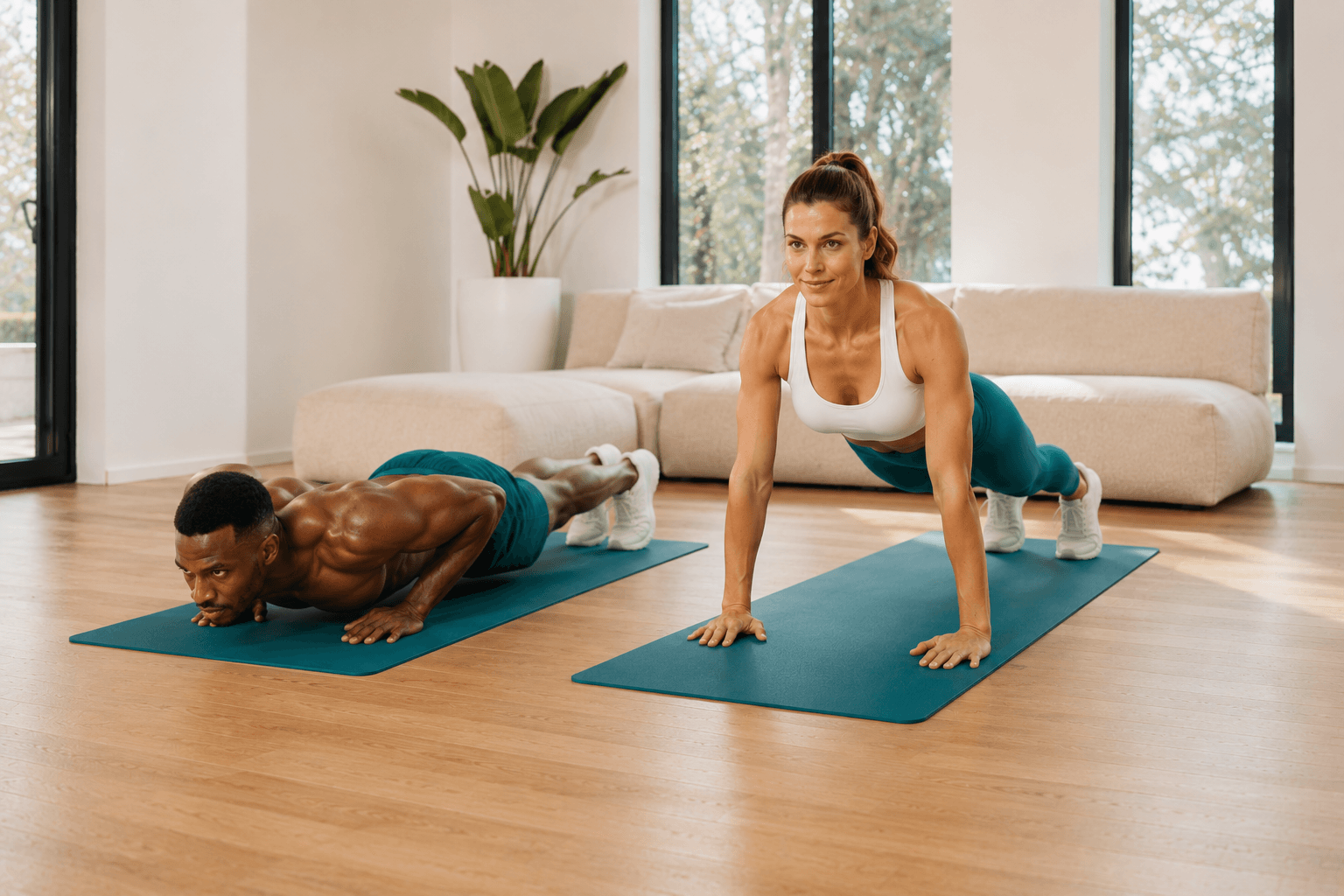
The biggest fitness mistake isn’t being a beginner. Honestly, it’s believing you have to perform every exercise exactly the way everyone else does.
Have you ever watched a workout video and quietly thought, “I can’t do that”? Maybe push-ups bother your wrists. Perhaps lunges nag at your knees. Or burpees leave you completely winded after just a handful of reps. For a lot of people, that’s exactly where the workout ends — they decide the session simply isn’t for them and walk away.
Here’s the more encouraging truth, though: nearly every bodyweight exercise can be adjusted to fit you. That’s the whole idea behind exercise modifications, and it’s the difference between quitting and quietly building strength week after week.
Quick Answer: What Are Exercise Modifications?
Exercise modifications let you make a movement easier or harder based on your current fitness level. Rather than skipping an exercise because it feels too difficult — or too easy — you adjust it to match your ability. Done well, smart modifications improve technique, lower your injury risk, build confidence, and support steady, long-term progress.
Why Smart Modifications Beat “Pushing Through”
Think of every movement as a ladder rather than a pass-or-fail test. At the bottom you have a gentle regression; in the middle sits the standard version; and near the top you’ll find a tougher progression. The pattern is always the same: regression → standard → progression.
Because of that, there’s genuinely no “right” place to begin. The best version of any exercise is simply the one you can perform with excellent technique while still feeling challenged. If you’re brand new to training, our beginner workout guides are a friendly place to start.
Upper Body Modifications
Let’s begin with the upper body, since this is where many people first feel stuck. For a complete routine, you can also follow our ultimate upper body workout at home.
Push-Up Progressions
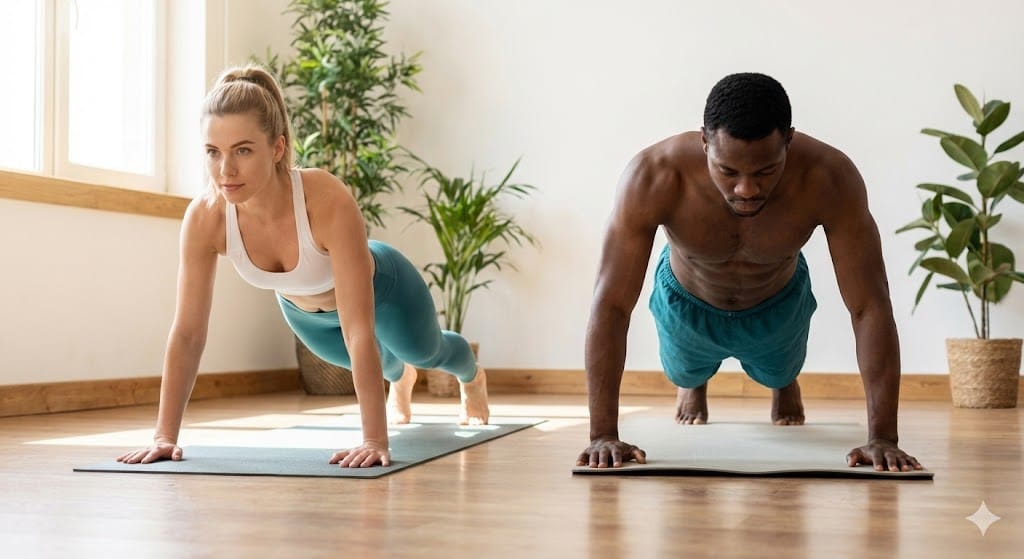
Indeed, the push-up is one of the best bodyweight exercises around, because it strengthens your chest, shoulders, triceps, and core all at once. If a standard push-up feels too hard right now, don’t skip it — instead, simply choose an earlier step on the ladder.
Level 1: Wall Push-Up
To begin, stand about an arm’s length from a wall, place your hands at shoulder height, then lower your chest toward the wall before pressing back. Consequently, this version is ideal for complete beginners, older adults, anyone returning after a break, and those rebuilding confidence.
Level 2: Counter Push-Up
Next, use a sturdy kitchen counter, table, or bench. Because your body sits more horizontally than in a wall push-up, the challenge increases nicely.
Level 3: Knee Push-Up
From here, perform the movement on your knees while keeping a straight line from your knees to your shoulders. Just be sure to avoid bending at the hips.
Level 4: Standard Push-Up
Now for the classic: hands beneath your shoulders, core engaged, and your body in one straight line. Lower with control, then press back up.
Level 5: Decline Push-Up
When you’re ready for more, elevate your feet on a sturdy chair or step. This shifts additional body weight toward your upper body.
Level 6: Archer Push-Up
Finally, the archer push-up: one arm does most of the work while the opposite arm provides only light assistance. It’s a powerful stepping stone toward the one-arm push-up.
Triceps Dip Progressions
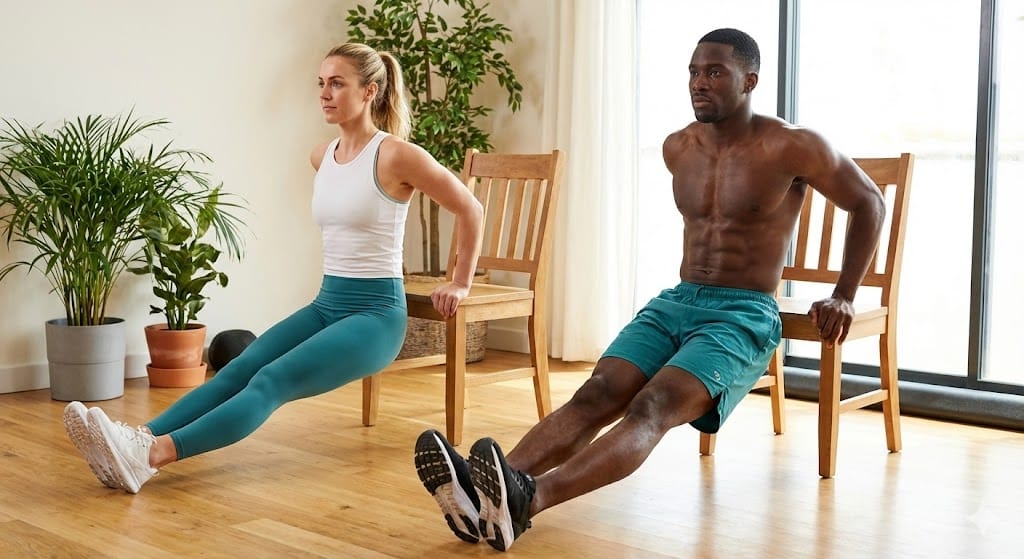
Meanwhile, dips target the backs of your arms while also strengthening your shoulders and chest. As with push-ups, there’s a gentle on-ramp for every level.
- Level 1 – Wall Triceps Press: Stand facing a wall, bend your elbows, and press away. A gentle introduction.
- Level 2 – Chair Dip (knees bent): Hands on a sturdy chair, feet close to your body, small range of motion.
- Level 3 – Standard Chair Dip: Extend your legs a little further and increase depth gradually.
- Level 4 – Straight-Leg Dip: With legs fully extended, more body weight travels through your arms.
- Level 5 – Single-Leg Dip: Lift one foot slightly off the floor so your working arm supports more load.
Common dip mistakes to avoid: dropping the shoulders, descending too deeply, and locking out aggressively at the top.
Plank Progressions
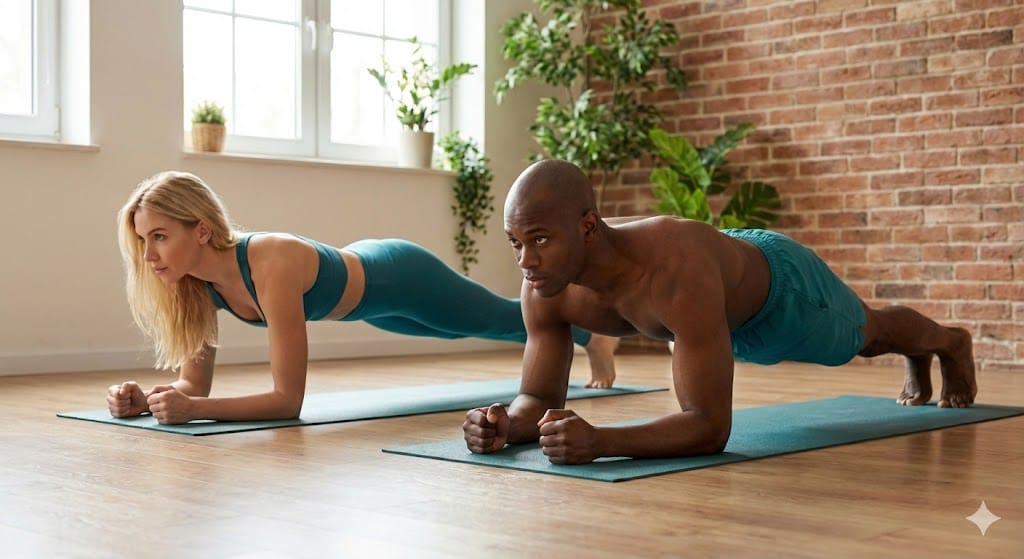
Although the plank looks simple, it actually trains your entire core. Therefore, to build a rock-solid hold, work through these steps in order:
- Level 1 – Incline Plank: Hands on a wall or counter for a supported start.
- Level 2 – Knee Plank: Keep your knees down while bracing the core.
- Level 3 – Forearm Plank: Rest on your forearms with elbows under your shoulders.
- Level 4 – High Plank: Hold the top of a push-up position with steady breathing.
- Level 5 – Shoulder Tap Plank: Tap each hand to the opposite shoulder while keeping your hips still.
- Level 6 – Plank Walk: Move between forearms and hands with full control.
Common plank mistakes: holding your breath, lifting the hips too high, or letting the lower back arch. As a helpful cue, brace your core as if someone is about to gently poke your stomach.
Mountain Climber Progressions
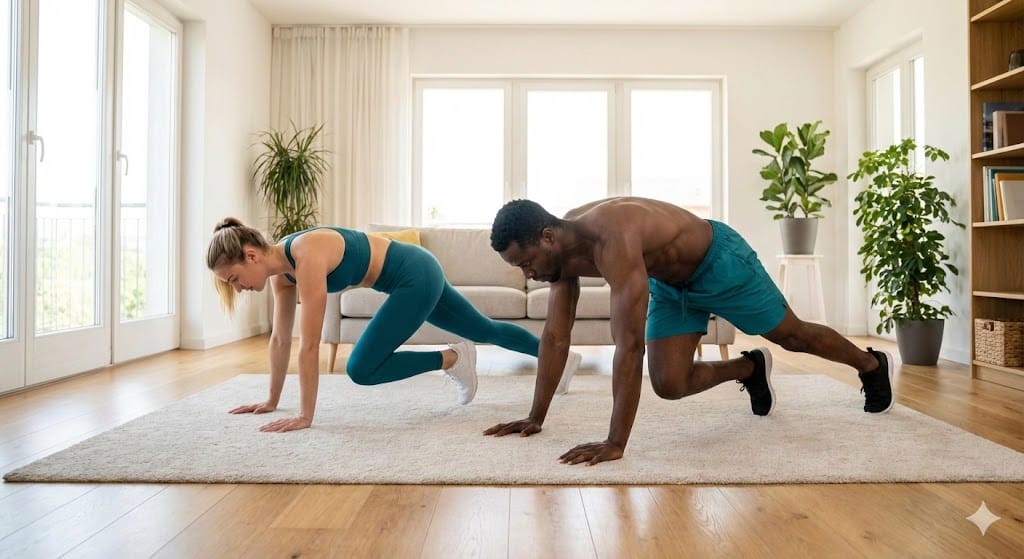
In addition, mountain climbers improve cardio fitness, core strength, and coordination together. To keep your form clean, build up gradually:
- Level 1 – Standing Mountain Climber: Lift one knee at a time while standing.
- Level 2 – Slow Mountain Climber: Move deliberately from a plank position.
- Level 3 – Standard Mountain Climber: Alternate knees smoothly with a steady rhythm.
- Level 4 – Cross-Body Mountain Climber: Drive each knee toward the opposite elbow for extra rotational core work.
- Level 5 – Fast Mountain Climber: Increase speed only once your technique stays excellent.
Watch out for: bouncing excessively, rounding the shoulders, or losing plank alignment. Keep your shoulders stacked directly above your wrists.
Burpee Progressions
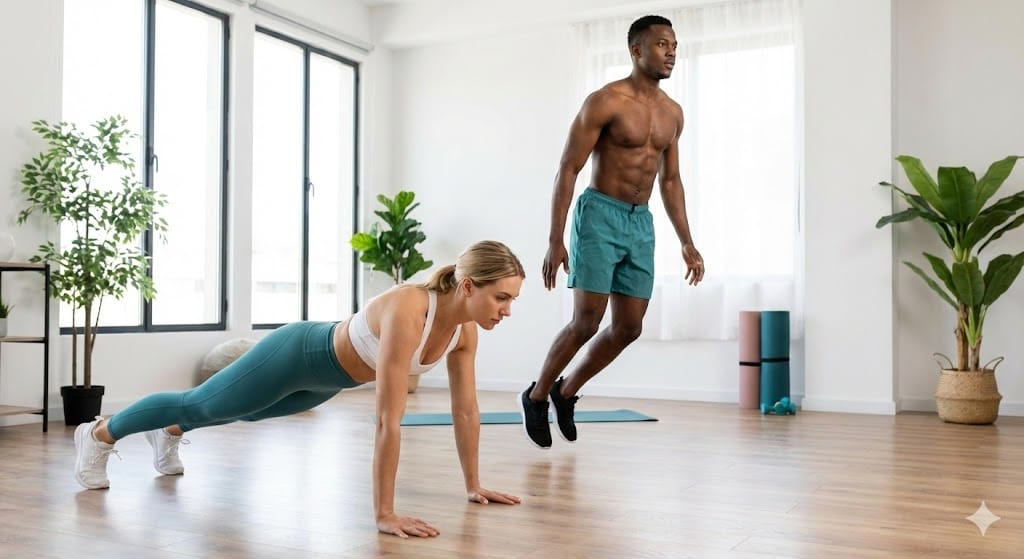
Admittedly, few exercises intimidate beginners more than burpees. Fortunately, they break down into surprisingly manageable steps:
- Level 1 – Squat to Reach: Squat down, reach overhead, then stand.
- Level 2 – Step-Back Burpee: Step one foot back at a time, with no jumping.
- Level 3 – Standard Burpee: Add a light hop as you return to standing.
- Level 4 – Burpee with Push-Up: Include a push-up at the bottom of each rep.
Lower Body Modifications
Now let’s move to the lower body. These movements build the strength you rely on every single day — from climbing stairs to carrying groceries. If you want a dedicated routine, our no-equipment leg workout pairs perfectly with the progressions below.
Squat Progressions
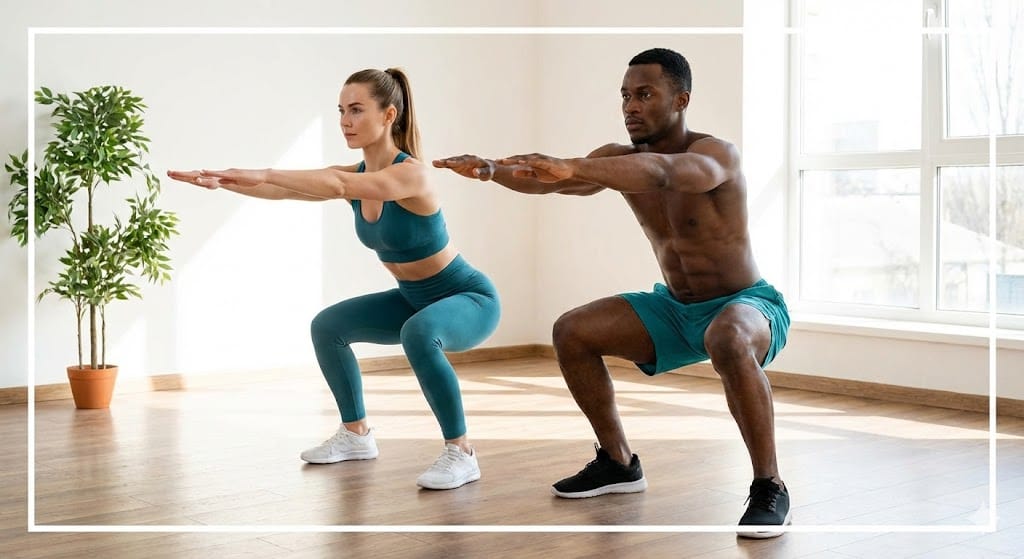
First of all, squats strengthen your legs and glutes while reinforcing healthy, everyday movement patterns. Wherever you currently sit on the ladder, there’s a step for you:
- Level 1 – Chair Squat: Sit back to a chair, then stand. Perfect for building confidence.
- Level 2 – Box Squat: Lightly tap a surface before rising for a controlled depth.
- Level 3 – Bodyweight Squat: Lower until your thighs are roughly parallel to the floor.
- Level 4 – Pause Squat: Hold the bottom position briefly to build control.
- Level 5 – Pistol Squat (assisted): Work toward a single-leg squat with light support.
As a simple cue, push the floor away through your heels and keep your chest proud.
Lunge Progressions
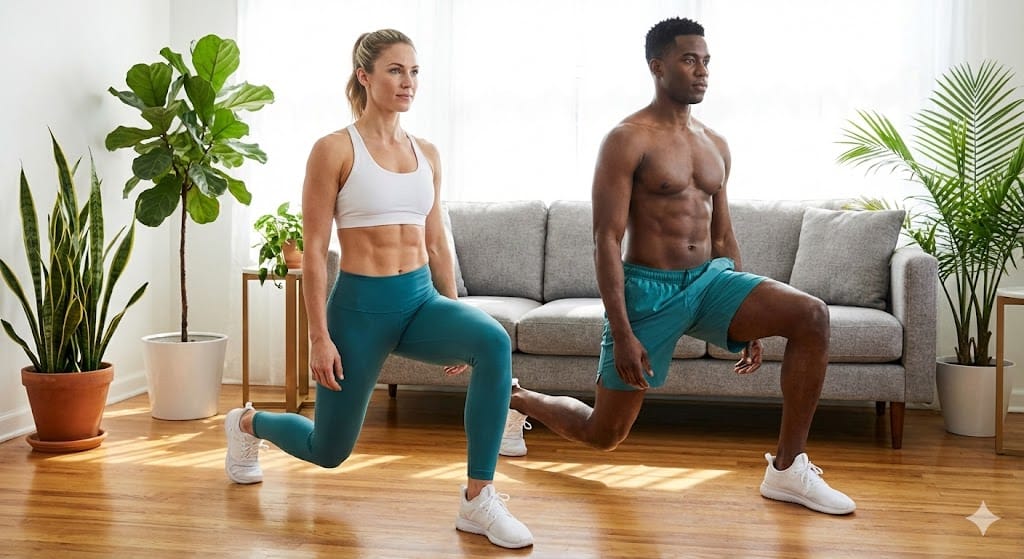
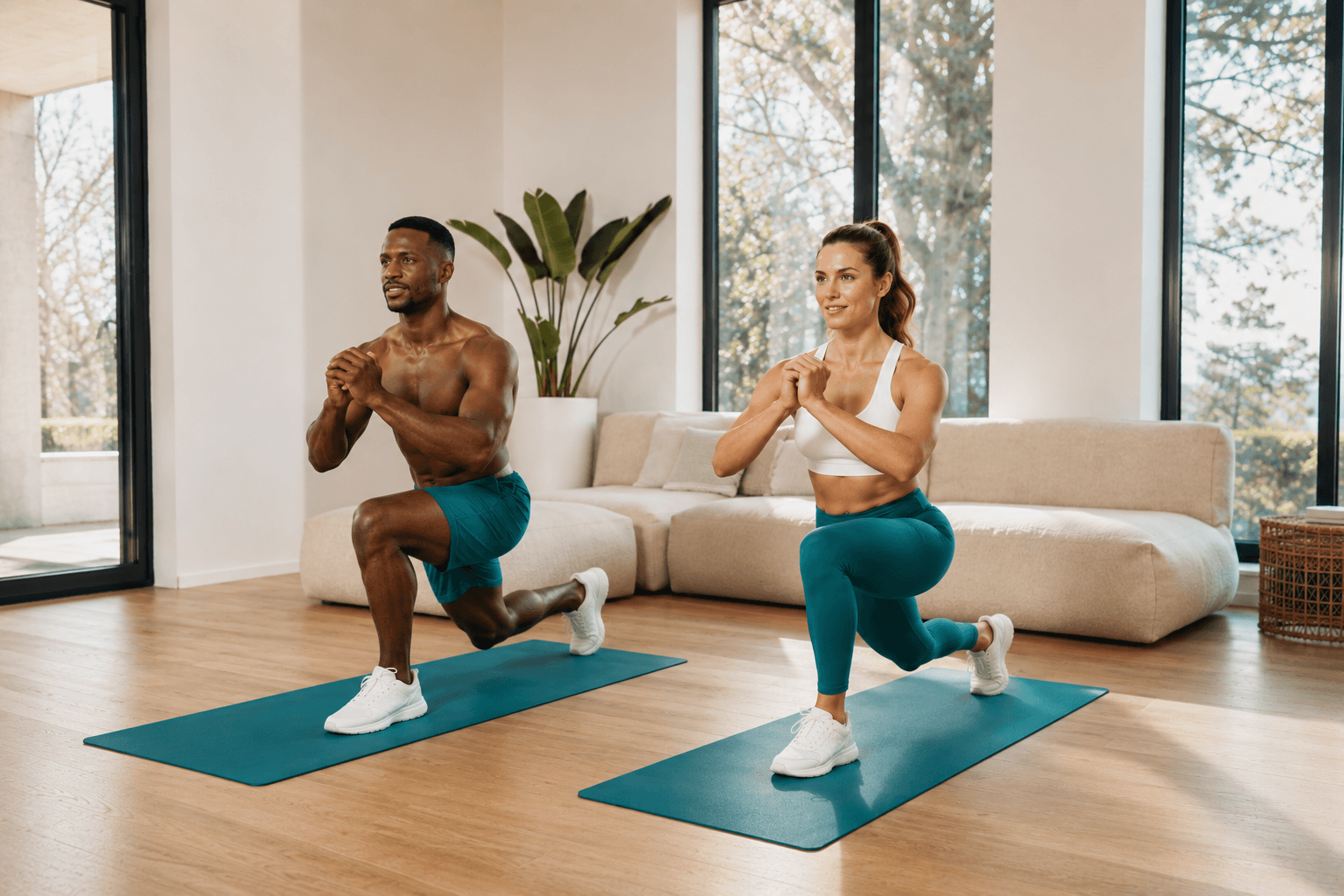
Similarly, lunges develop balance, coordination, and single-leg strength. Notably, reverse lunges tend to feel kinder on the knees than forward lunges, so they make a great starting point:
- Level 1 – Supported Reverse Lunge: Hold a wall or chair for balance.
- Level 2 – Reverse Lunge: Step back and lower with control.
- Level 3 – Forward Lunge: Step forward once your balance feels solid.
- Level 4 – Walking Lunge: Move continuously across the room.
- Level 5 – Jumping Lunge: Add an explosive switch between legs.
Step-Up Progressions
Furthermore, step-ups translate directly into real-world activities like climbing stairs, which makes them especially valuable.
- Level 1 – Low Step: Use the bottom stair and focus on control.
- Level 2 – Standard Step-Up: Raise the platform height slightly and drive through your leading foot.
- Level 3 – Knee Drive Step-Up: Lift the opposite knee at the top to challenge your balance.
- Level 4 – Weighted Step-Up (optional): Once bodyweight feels easy, you may eventually add resistance if it suits your goals.
Throughout, push through the leading foot rather than jumping off the trailing leg.
Calf Raise Progressions
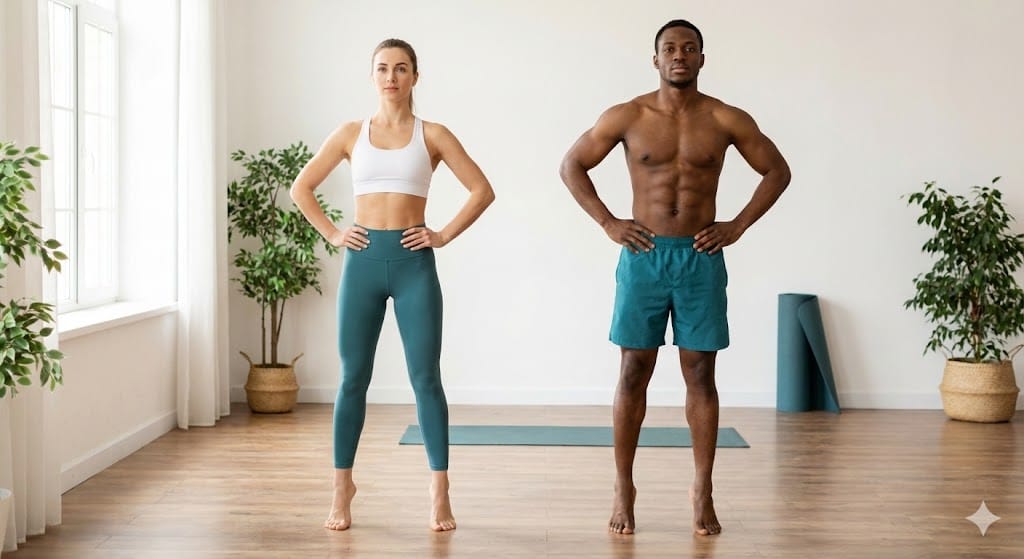
Although often overlooked, calf raises are genuinely valuable because they improve ankle stability while supporting walking, running, and jumping:
- Level 1 – Supported Calf Raise: Hold a wall and rise onto your toes.
- Level 2 – Standard Calf Raise: Perform the same movement without support.
- Level 3 – Single-Leg Calf Raise: Let one leg do all the work.
- Level 4 – Pause Calf Raise: Hold the top, then lower slowly.
Move slowly through the entire range of motion for the best results.
Jump Squat Progressions

Because power should always be built gradually, jump squats truly deserve a patient approach:
- Level 1 – Bodyweight Squat: Master the basic pattern first.
- Level 2 – Fast Squat: Speed up the movement while staying controlled.
- Level 3 – Small Hop Squat: Add a gentle hop at the top.
- Level 4 – Full Jump Squat: Drive up explosively and land softly.
A useful landing cue: aim to land as quietly as possible. If your landing sounds loud, simply reduce the jump height.
Knee-Friendly Exercise Alternatives
Indeed, many people avoid exercise simply because certain movements make their knees uncomfortable. Often, though, a small swap solves the problem entirely. Here are a few gentle trades to try:
- Swap forward lunges for reverse lunges.
- Swap deep squats for chair squats.
- Swap jump squats for pause squats.
- Swap burpees for step-back burpees.
- Swap jumping jacks for step jacks.
Remember that occasional discomfort isn’t the same as an injury. That said, persistent or worsening knee pain should always be assessed by an appropriately qualified healthcare professional. For gentle joint care between sessions, our home mobility routine can help.
Wrist-Friendly Exercise Alternatives
Are push-ups uncomfortable on your wrists? If so, these adjustments can make a surprisingly big difference:
- Try wall push-ups or counter push-ups to reduce the angle.
- Use push-up handles to keep wrists neutral.
- Experiment with closed-fist push-ups, only if they feel comfortable.
- Choose forearm planks instead of high planks.
Build Your Own Modified Workout
For instance, here’s how three different fitness levels can complete the very same workout using appropriate variations. In other words, everyone trains, everyone improves, and ultimately everyone simply starts in a slightly different place.
| Exercise | Beginner | Intermediate | Advanced |
|---|---|---|---|
| Push-Up | Wall Push-Up | Standard Push-Up | Archer Push-Up |
| Squat | Chair Squat | Bodyweight Squat | Pistol Squat |
| Lunge | Supported Reverse Lunge | Reverse Lunge | Jumping Lunge |
| Plank | Knee Plank | Forearm Plank | Shoulder Tap Plank |
| Burpee | Step-Back Burpee | Standard Burpee | Burpee with Push-Up |
Looking for a ready-made session? Our 15-minute full body workout at home uses this exact “scale-to-your-level” approach.
Common Modification Mistakes to Avoid
Of course, modifying intelligently is a skill in itself. To get the most from it, therefore, keep these three pitfalls in mind.
Rushing Past Your Current Level
An advanced variation performed poorly is rarely more effective than an easier variation performed well. Movement quality always comes first.
Skipping Foundational Exercises
Many advanced skills quietly depend on mastering the simpler movements first. So respect the process, and let the basics do their job.
Letting Ego Make the Call
One of the smartest things you can say mid-workout is, “I’m not ready for that variation yet.” Far from being failure, that’s intelligent training in action.
The Sanook Progress Formula
Ultimately, picture every exercise as a ladder. The climb then follows a simple, repeatable loop:
- Learn the movement pattern.
- Practise it consistently.
- Master the current level.
- Progress to the next step.
- Repeat the whole cycle again.
Every new level restarts the same process — and that’s exactly what keeps training fresh and interesting over the long haul.
Expert Coaching Advice from Sanook Fit
After coaching people of all ages and fitness levels, we’ve learned one lesson again and again: the people who improve fastest aren’t necessarily the strongest. Rather, they’re the ones who consistently choose the right challenge. With that in mind, here are five principles we encourage every Sanook Fit member to follow:
- Earn every progression. Don’t rush — build a solid base first.
- Prioritise technique over intensity. Clean reps beat sloppy ones every time.
- Stay consistent. Small, regular efforts outperform occasional heroics.
- Listen to your body. Discomfort and pain are two different signals.
- Celebrate small wins. Each modification mastered is real, measurable progress.
Curious whether bodyweight training is “enough” on its own? Our guide on whether you can build muscle without lifting weights tackles that question head-on, and we bust plenty of myths in our bodyweight training myths debunked article too.
Your Next Step Starts Today
For years, people believed they had to perform every exercise exactly as demonstrated. Now, however, you know that simply isn’t true. After all, every push-up has a starting point, every squat has a progression, every plank has an alternative, and every burpee has an easier version. That’s the real beauty of bodyweight training — it adapts to you.
Whether you’re taking your very first chair squat or working toward your first pistol squat, you’re following the same path. You’re simply standing on different rungs of the same ladder. At Sanook Fit, we believe fitness should never leave you feeling excluded — it should leave you feeling capable.
So choose the variation that matches your ability today. Then practise it consistently, celebrate your progress, and take the next step when you’re ready. Ultimately, that’s how lasting strength is built: one modification, one repetition, and one workout at a time.
Want guided routines, demos, and daily motivation? Follow Sanook Fit on YouTube, TikTok, Facebook, and Instagram — and train with us wherever you are.
Recommended References
To support this guide, we’ve drawn on trusted, evidence-based resources. For further reading, explore: