Quick answer: Both home workouts and the gym can build strength, support weight loss, and improve your overall health. Ultimately, the right choice comes down to your lifestyle, goals, budget, and — most importantly — which option you’ll actually stick with. For many of us, in fact, simple bodyweight workouts at home turn out to be the most practical, affordable, and sustainable way to get stronger and stay active, with no equipment required.
Do You Really Need a Gym?
For starters, scroll through social media for five minutes and you’d be forgiven for thinking that getting fit requires a long shopping list:
- A premium gym membership
- Expensive machines
- Rows of dumbbells
- Designer workout clothes
- A protein shake after every session
As a result, it’s easy to believe fitness has become complicated. Honestly, though, the reality is much simpler.
In fact, long before commercial gyms existed, people built strength simply through movement. For example, they climbed, carried, pushed, pulled, squatted, and ran. As a result, their bodies adapted, because they kept moving consistently.
Today, of course, we have more options than ever. For instance, commercial gyms offer fantastic facilities, home workouts are more accessible than they’ve ever been, and online coaching lets you train just about anywhere. Therefore, the real question was never “Which is better?” but rather “Which one will you actually stick with?” Because, in the end, the most effective workout program usually isn’t the most expensive one — it’s the one that quietly becomes part of your life.
Why This Question Really Matters
Every year, millions of people start a fitness journey, yet many never make it past the first few months. However, it’s rarely because they’re lazy. More often, life simply gets in the way. For instance, busy work schedules, family responsibilities, long commutes, travel, and the rising cost of living all chip away at our best intentions.
That’s exactly why the home-versus-gym decision is worth thinking through. Instead of asking which option looks most impressive, it helps to ask which one makes it easiest for you to keep moving throughout the year. After all, consistency almost always beats perfection.
The Sanook Fit Philosophy
At Sanook Fit, we believe fitness should fit around your life — not the other way around. In other words, you shouldn’t need expensive equipment to improve your health, and you definitely shouldn’t feel guilty when you can’t make it to a gym. After all, a short home workout still counts. Likewise, every workout counts, every walk counts, and every healthy choice counts.
Put simply, our mission is to help people of every age, ability, and background discover that exercise can be practical, enjoyable, and sustainable — wherever they choose to train.
💡 Sanook Fit Coach’s Tip: Don’t pick the workout that looks most impressive. Pick the one you’ll still be doing six months from now. Long-term consistency beats short bursts of motivation every single time.
Home Workouts vs Gym: Which One Gets Better Results?
First, let’s clear up one of the biggest misconceptions in fitness: the idea that one option is universally better than the other. In reality, the truth is more interesting, because both home and gym workouts can improve your health, build strength, and help you reach your goals. Therefore, the biggest difference usually isn’t the location — it’s how consistently you train.
1. Building Strength
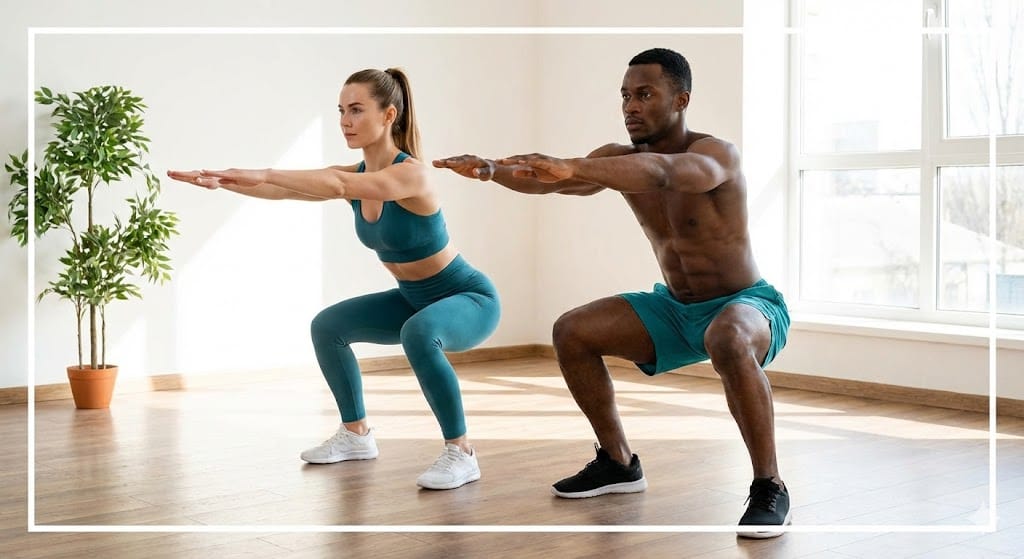
On one hand, gyms shine when it comes to progressive overload with heavy external weights, which makes them especially valuable for advanced lifters chasing maximum muscle size. On the other hand, for beginners and intermediate exercisers, bodyweight training offers more than enough challenge to build real, usable strength.
| Goal | Best Option |
|---|---|
| Beginner muscle growth | Home or gym |
| General strength | Home or gym |
| Maximum muscle size | Gym |
| Functional strength | Home workouts |
| Athletic movement | Home workouts |
2. Losing Weight
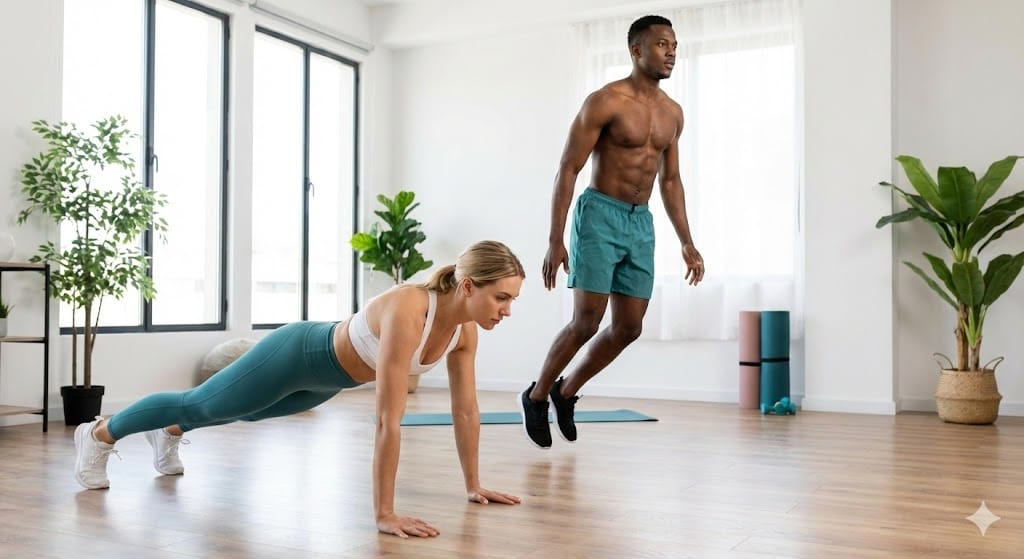
Meanwhile, many people assume gyms automatically burn more calories. In truth, not necessarily. Instead, calorie expenditure depends far more on workout intensity, duration, exercise selection, and consistency than on the building you happen to be standing in.
Moreover, a well-designed bodyweight circuit can raise your heart rate and strengthen your muscles at the same time. For instance, movements like burpees, mountain climbers, squats, push-ups, and jumping jacks blend strength and cardio into one efficient session. As always, the best weight-loss program is simply the one you’ll keep doing.
3. Convenience, Cost, and Everyday Life
In particular, this is where home workouts quietly pull ahead for many people. To begin with, there’s no commute, no membership fee, and no waiting for equipment. Better still, you can train in the privacy of your own space, fit a session around the kids or a busy workday, and keep your routine going even when you’re travelling — whether in a hotel room, a park, a garden, or a quiet corner of the office. In short, your gym travels with you.
A Quick Side-by-Side Comparison
| Category | Home Workout | Gym |
|---|---|---|
| Convenience | ⭐⭐⭐⭐⭐ | ⭐⭐⭐ |
| Cost | ⭐⭐⭐⭐⭐ | ⭐⭐⭐ |
| Muscle building | ⭐⭐⭐⭐ | ⭐⭐⭐⭐⭐ |
| Weight loss | ⭐⭐⭐⭐⭐ | ⭐⭐⭐⭐⭐ |
| Flexibility | ⭐⭐⭐⭐⭐ | ⭐⭐⭐ |
| Equipment variety | ⭐⭐ | ⭐⭐⭐⭐⭐ |
| Privacy | ⭐⭐⭐⭐⭐ | ⭐⭐ |
| Family friendly | ⭐⭐⭐⭐⭐ | ⭐⭐ |
| Travel friendly | ⭐⭐⭐⭐⭐ | ⭐⭐ |
| Long-term consistency | ⭐⭐⭐⭐⭐ | Depends on the individual |
Which Option Is Right for You?
For example, home workouts may suit you if you have a busy schedule, prefer flexibility, want to save money, feel more comfortable exercising privately, enjoy bodyweight training, or travel frequently.
On the other hand, a gym may suit you if you love lifting heavy weights, thrive in a social environment, have advanced strength goals, or want access to specialist equipment. Either way, of course, there’s no rule saying you have to choose just one.
Try These 4 No-Equipment Home Workouts
So, ready to put the theory into practice? Below, you’ll find four simple bodyweight workouts you can do almost anywhere. First, though, always start with a few minutes of easy movement — for example, arm circles, leg swings, and some marching on the spot — so that you finish your warm-up feeling ready to move, not tired.
Workout 1: The 15-Minute Busy-Day Workout
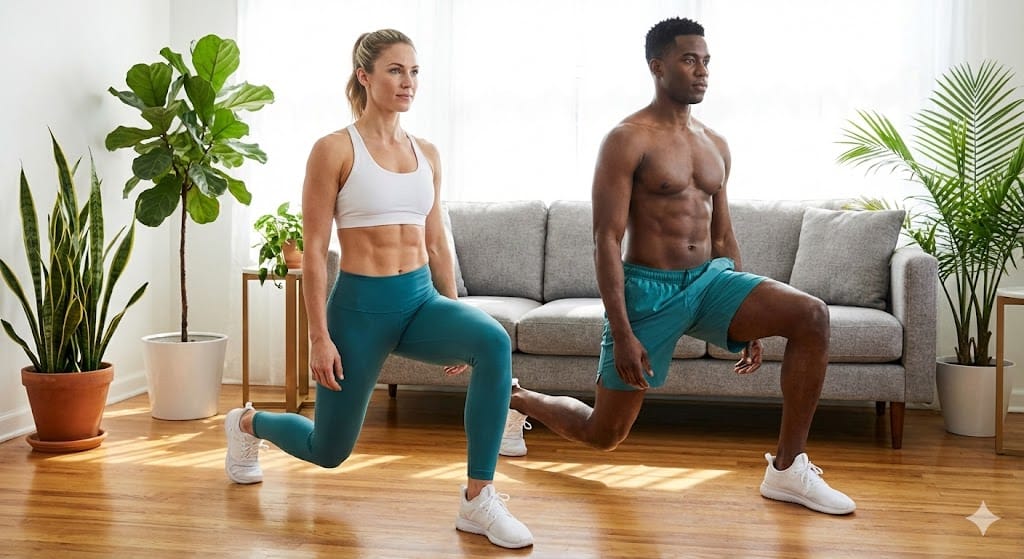
First up, this one is perfect for busy professionals, parents, beginners, or anyone short on time. To do it, perform each exercise for 40 seconds, then rest 20 seconds, and finally complete 2 rounds.
- Bodyweight squats
- Incline push-ups
- Reverse lunges
- Glute bridges
- Bird dogs
- March in place
Even though it’s short, this workout trains your whole body. Above all, move with control, don’t rush to finish, and focus on quality movement, because consistency matters far more than duration.
Workout 2: The 20-Minute Fat-Burning Circuit
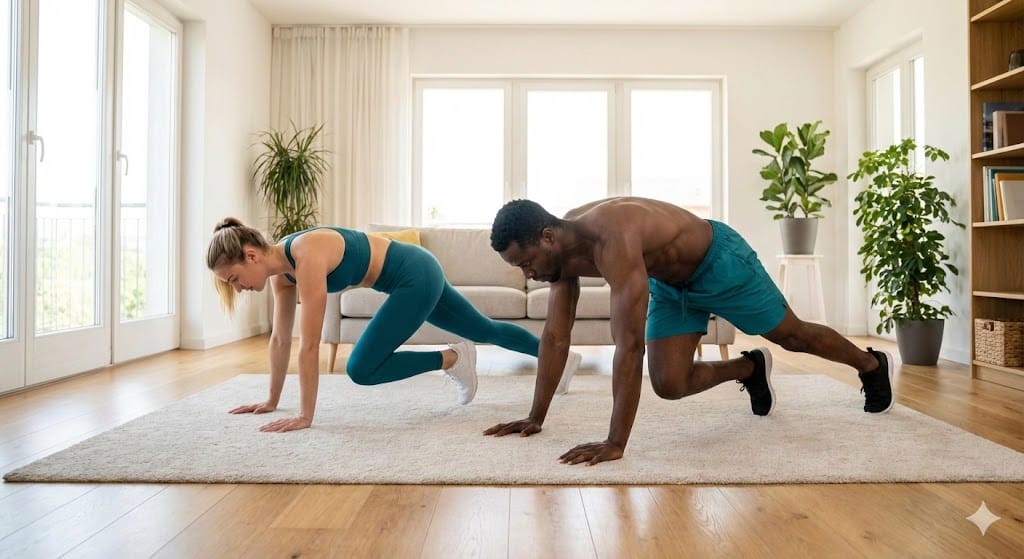
Next, if your goal is improving fitness while burning more calories, then this circuit blends strength and cardio. Specifically, perform each exercise for 45 seconds, then rest 15 seconds, and finally complete 3 rounds.
- Squats
- Push-ups
- Mountain climbers
- High knees
- Reverse lunges
- Plank
Naturally, you can expect your heart rate to climb — just keep your technique clean throughout.
Workout 3: The 30-Minute Strength Builder
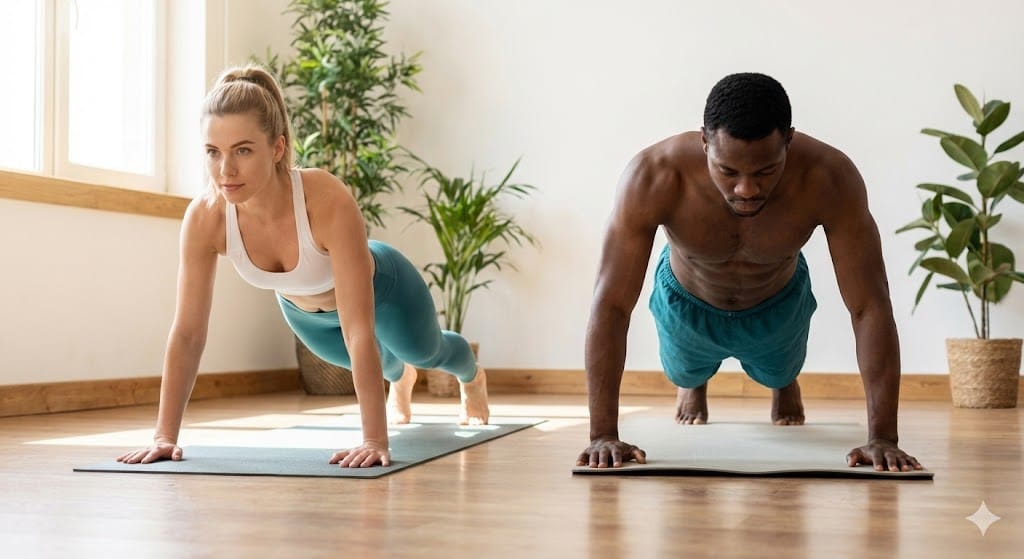
Strength isn’t only about lifting heavy weights. On the contrary, controlled bodyweight training develops impressive muscular endurance and functional strength. To do it well, complete 3 sets, rest 60 seconds between sets, and focus on smooth, controlled repetitions.
| Exercise | Reps |
|---|---|
| Squats | 15 |
| Push-ups | 12 |
| Reverse lunges | 10 each leg |
| Glute bridges | 15 |
| Plank | 45 sec |
| Bird dogs | 12 each side |
Workout 4: The No-Gym Challenge
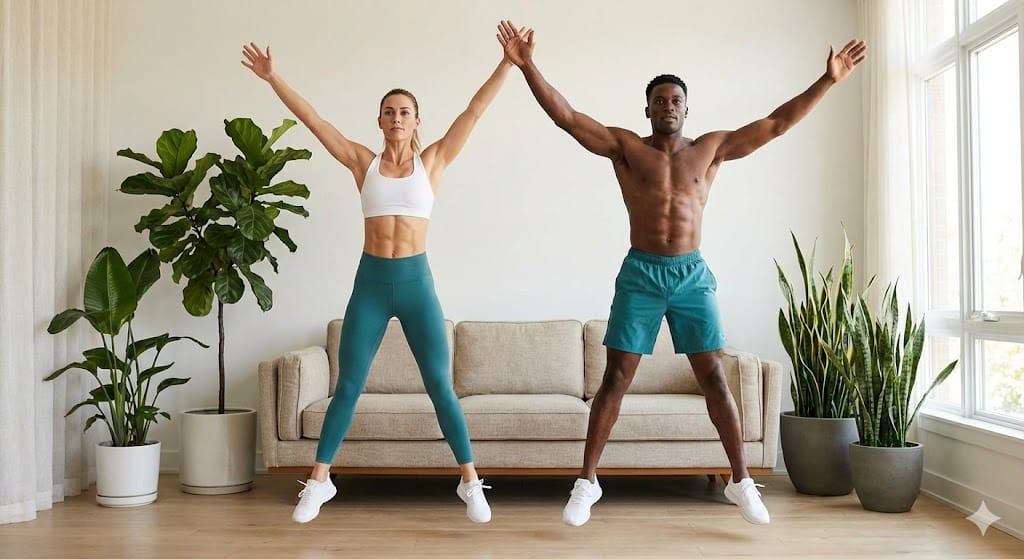
Want to prove you don’t need a gym? Then try this one. Afterwards, rest 90 seconds between rounds and repeat 2 to 4 rounds. Admittedly, it’s demanding, since it combines strength, endurance, and cardiovascular fitness in one go.
- Jumping jacks
- Squats
- Push-ups
- High knees
- Plank (60 sec)
A Simple Weekly Home Workout Schedule
Above all, structure makes consistency easier. For instance, here’s an example week you can adapt to your own life:
| Day | Focus |
|---|---|
| Monday | Full-body strength |
| Tuesday | Walking + mobility |
| Wednesday | Cardio circuit |
| Thursday | Recovery |
| Friday | Full-body strength |
| Saturday | Sanook challenge |
| Sunday | Light activity or yoga |
Overall, this gives you enough training to make progress while still leaving room to recover. In addition, if you want to keep your core strong, pair these sessions with our companion guide below.
Can Bodyweight Moves Really Replace Gym Exercises?
Absolutely. In fact, most gym machines have an excellent bodyweight alternative — you simply trade the equipment for smart technique.
| Gym Exercise | Bodyweight Alternative |
|---|---|
| Leg press | Bodyweight squat |
| Chest press | Push-up |
| Shoulder press | Pike push-up |
| Leg curl | Glute bridge |
| Crunch machine | Plank |
| Cardio machine | Mountain climbers |
| Step machine | Reverse lunges |
| Cable core work | Bird dog |
Recovery Builds Results
Exercise creates the stimulus; meanwhile, recovery is when your body actually adapts, so don’t overlook it. Ideally, aim for 7 to 9 hours of sleep each night, take light walks to encourage circulation and ease stiffness, and spend a few minutes on mobility work after training to improve how you move over time. Remember, rest days aren’t a sign of weakness — they’re part of the plan.
How to Stay Consistent
Most people don’t stop training because their workouts are ineffective. Rather, they stop because life gets busy. Fortunately, these small habits make a big difference:
- Schedule your workout and treat it like an important meeting.
- Keep your space ready — leave your mat somewhere visible so it takes less effort to start.
- Track your progress by noticing better technique, more repetitions, and faster recovery, not just the number on the scale.
5 Fitness Myths Worth Letting Go Of
Myth #1: “You can’t build muscle without a gym.” In reality, progressive overload can be achieved at home by changing leverage, tempo, balance, or exercise difficulty — no extra equipment needed.
Myth #2: “Bodyweight training is only for beginners.” On the contrary, adjusting leverage and tempo keeps movements challenging well into the advanced stages.
Myth #3: “Gym workouts are always better.” Actually, the best workout is the one you complete consistently. By comparison, a fantastic gym program does little if you rarely attend.
Myth #4: “You need an hour every day.” However, health authorities such as the World Health Organization and the CDC consistently support the benefits of regular activity, even in shorter sessions. For example, a focused 20-minute workout done a few times a week can make a meaningful difference.
Myth #5: “Exercise has to be miserable.” In truth, enjoyment is one of the strongest predictors of sticking with it — which is exactly the philosophy behind Sanook Fit.
Expert Coaching Advice from Sanook Fit
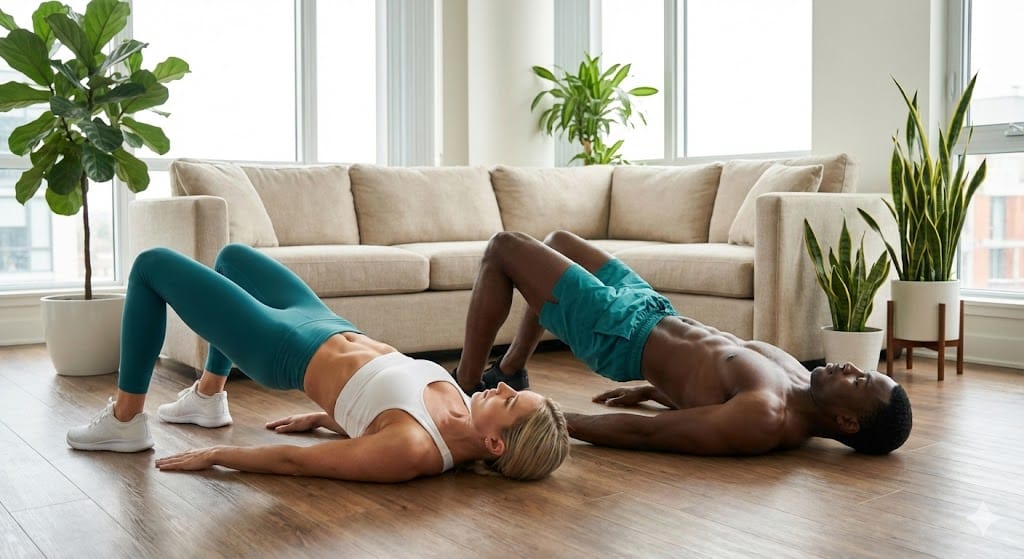
After coaching hundreds of home workouts, one lesson stands above the rest. Namely, the people who succeed aren’t the ones with the best genetics or the most expensive equipment. Instead, they’re the ones who remove barriers and keep showing up. With that in mind, here are a few things that help:
- Start small. A short workout you finish beats a long one you skip.
- Make it easy to begin. Reduce friction so starting feels effortless.
- Focus on how you feel. Greater confidence, more energy, better sleep, improved balance, and easier daily activities often show up well before dramatic changes on the scale.
- Enjoy the journey. Fitness isn’t a 30-day project — it’s a lifelong investment. Play your favourite music, choose workouts that make you smile, and celebrate every improvement. That’s what sanook is all about.
Signs You’re Making Progress
Of course, progress isn’t always obvious in the mirror. Therefore, look for these signs instead:
- Completing more repetitions
- Better exercise technique
- Faster recovery
- Improved mobility
- Climbing stairs more easily
- Carrying groceries with less effort
- More energy through the day
- Sleeping better
- Feeling more confident
Home Workout, Gym, or Both?
By now, you’ve probably realised this was never really an either/or question. Indeed, many people thrive by combining both — gym sessions when they want heavy weights or a change of scene, and home workouts to stay consistent on busy days. Ultimately, the right mix is simply the one that keeps you moving.
Join the Free 30-Day Sanook Fit Challenge
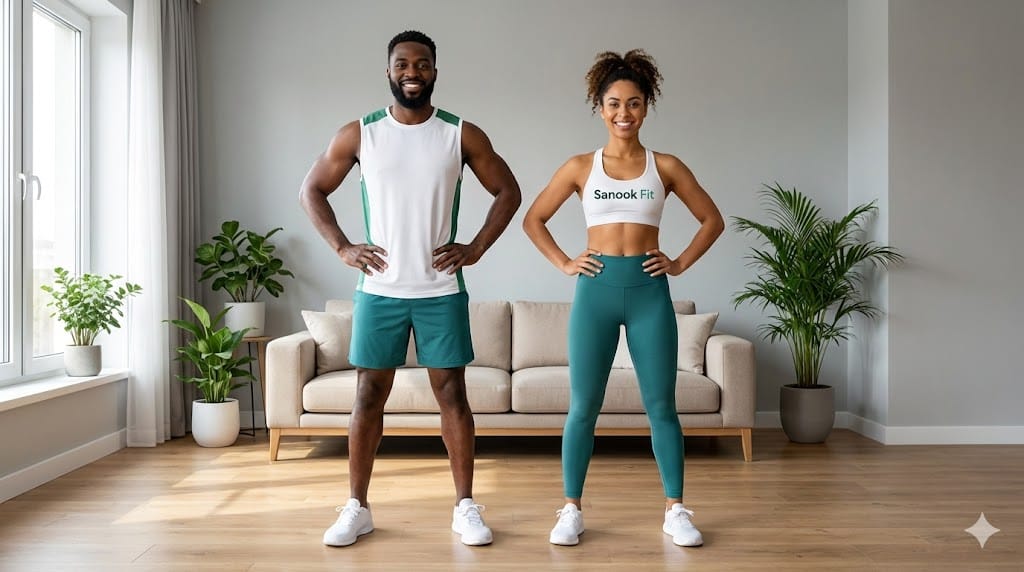
So, if you’re ready to stop comparing options and finally start making progress, then the 30-Day Sanook Fit Challenge is a great next step. Specifically, you’ll get:
- ✅ Daily follow-along bodyweight workouts
- ✅ No equipment required
- ✅ Beginner-friendly progressions
- ✅ Strength, cardio, and mobility sessions
- ✅ Short workouts that fit into real life
In short, no guesswork and no expensive equipment — just a clear plan and the encouragement to keep moving. Meanwhile, follow along and share your progress with us on Instagram, YouTube, TikTok, and Facebook.
Final Thoughts
Finally, the debate between home workouts and gyms often misses the most important point. Put simply, your success won’t be decided by where you exercise — it’ll be decided by whether you keep exercising. For example, a gym full of world-class equipment can’t help if you never go, whereas a simple bodyweight workout at home can transform your health once you make it part of your routine.
So, choose the option that removes excuses. Likewise, choose the environment where you feel comfortable. Above all, choose the routine you’ll still be enjoying long after the motivation fades. In the end, that’s the Sanook way.