What really builds muscle, burns fat, and gets results — and what to stop believing today.
Stop Believing Fitness Myths. Start Building Real Strength.
Bodyweight training is an effective way to build strength, improve fitness, increase muscle endurance, and support healthy fat loss. Success depends on progressive overload, consistency, proper nutrition, and recovery, not whether resistance comes from gym equipment or your own body weight.
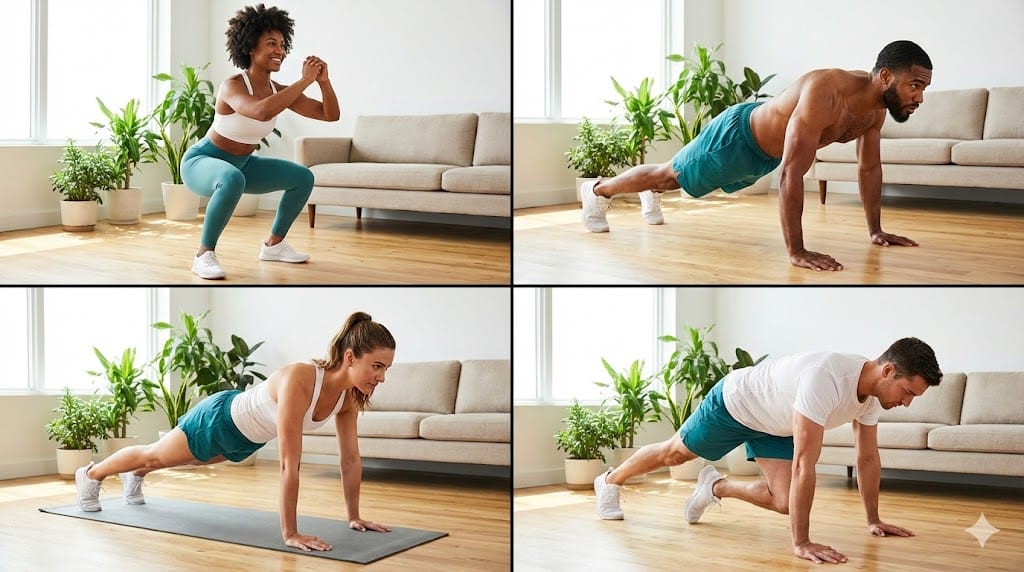
Why Fitness Myths Refuse to Die
If you’ve ever told someone you’re working out at home, you’ve probably heard at least one of these comments:
“You can’t build muscle without weights.”
“You’ll eventually stop making progress.”
“Bodyweight workouts are only for beginners.”
“You need a gym to get real results.”
These statements are repeated so often that many people accept them as facts.
The problem?
Most of them leave out an important detail.
The human body doesn’t respond to marketing.
It responds to challenge.
Your muscles don’t know whether resistance comes from a heavy barbell, a resistance band, or your own body weight.
They simply respond to the work you ask them to do.
That’s why elite gymnasts, calisthenics athletes, martial artists, climbers, and military personnel develop remarkable strength using relatively little equipment.
The science of adaptation hasn’t changed.
Only the myths have.
Why This Matters
Fitness myths don’t just spread misinformation.
They stop people from starting.
Someone who believes they need:
- A gym membership
- Expensive equipment
- Hours of free time
- The “perfect” program
is far more likely to postpone exercise altogether.
Meanwhile, someone who understands that meaningful progress can begin in their living room is already taking action.
At Sanook Fit, we want to remove those unnecessary barriers.
Because the biggest obstacle to better health often isn’t a lack of ability.
It’s believing the wrong information.
How Your Body Actually Adapts
Before we look at individual myths, it’s worth understanding one simple principle.
Your body adapts to the physical stress you place on it.
Every workout sends a message.
It says:
“Become stronger so this feels easier next time.”
That adaptation happens whether you’re performing:
- Push-Ups
- Pull-Ups
- Squats
- Lunges
- Planks
- Deadlifts
- Bench Press
The method changes.
The biology does not.
This concept is known as progressive overload.
As long as the challenge gradually increases over time, your body continues adapting.
What Is Progressive Overload?
Progressive overload simply means making an exercise slightly more challenging as your body becomes stronger.
Many people assume that requires heavier weights.
In reality, there are several ways to progress.
You can:
- Increase repetitions
- Perform a more difficult variation
- Slow the movement
- Increase range of motion
- Reduce rest periods
- Improve exercise quality
This is why bodyweight training can remain challenging for years.
Why Bodyweight Training Has Become So Popular
Bodyweight fitness isn’t a new trend.
It’s one of the oldest forms of exercise.
What’s changed is accessibility.
Today you can follow expert coaching from your living room without needing a commercial gym.
People are choosing bodyweight workouts because they:
- Save time
- Save money
- Build functional strength
- Improve mobility
- Require little space
- Travel anywhere
- Fit around busy schedules
Those practical advantages make consistency much easier.
Myth #1: You Can’t Build Muscle Without Weights
This is probably the most common bodyweight myth on the internet.
Fortunately, it’s also one of the easiest to explain.
The Truth
Muscles don’t recognise equipment.
They respond to:
- Mechanical tension
- Progressive overload
- Training close to fatigue
- Recovery
- Nutrition
If those ingredients are present, muscle growth can occur.
That’s why advanced bodyweight athletes often develop impressive physiques despite training with minimal equipment.
How Bodyweight Builds Muscle
Imagine these progressions.
Push-Up → Pause Push-Up → Decline Push-Up → Archer Push-Up → One-Arm Push-Up Progression
Each progression increases the challenge.
Your muscles continue adapting.
The same applies to lower-body training.
Bodyweight Squat → Split Squat → Bulgarian Split Squat → Shrimp Squat → Pistol Squat
The exercise changes.
The overload remains.
Common Mistake
Many beginners continue performing the same easy routine for months.
When progress slows, they blame bodyweight training.
In reality, they simply stopped progressing the exercises.
Sanook Fit Coach’s Tip 💡
Instead of asking, “Do I need heavier weights?” ask yourself:
“How can I make this movement slightly harder while maintaining perfect technique?”
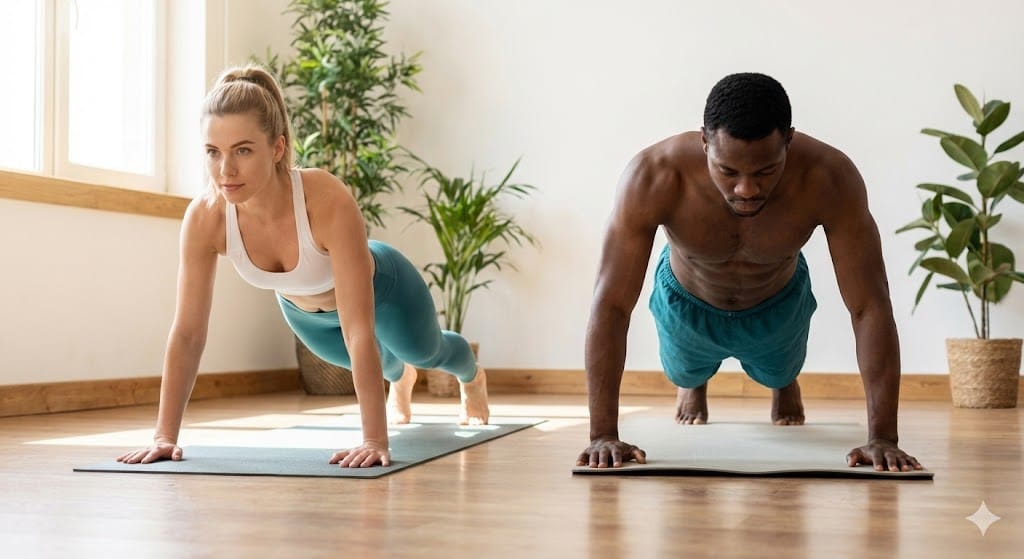
That question leads to consistent progress.
Myth #2: Bodyweight Training Is Only for Beginners
This myth often comes from seeing beginners perform wall push-ups or chair squats.
Those exercises are excellent starting points.
But they’re only the beginning.
The Truth
The ceiling for bodyweight strength is incredibly high.
Consider movements such as:
- Planche
- Front Lever
- Human Flag
- One-Arm Pull-Up
- Handstand Push-Up
These skills demand extraordinary strength, balance, coordination, and body control.
Even experienced weightlifters often find them surprisingly difficult.
Why Advanced Athletes Use Bodyweight Training
Many elite athletes include bodyweight exercises because they develop:
- Relative strength
- Core stability
- Joint control
- Balance
- Athletic coordination
These qualities transfer well to sports and everyday movement.
Beginner vs Advanced
A beginner might perform:
- Wall Push-Ups
An advanced athlete may perform:
- One-Arm Push-Ups
Same movement pattern.
Completely different level of difficulty.
Myth #3: You Can’t Build Strong Legs Without Heavy Weights
Many people assume bodyweight leg exercises become too easy after a few weeks.
Only if you stop progressing.
The Truth
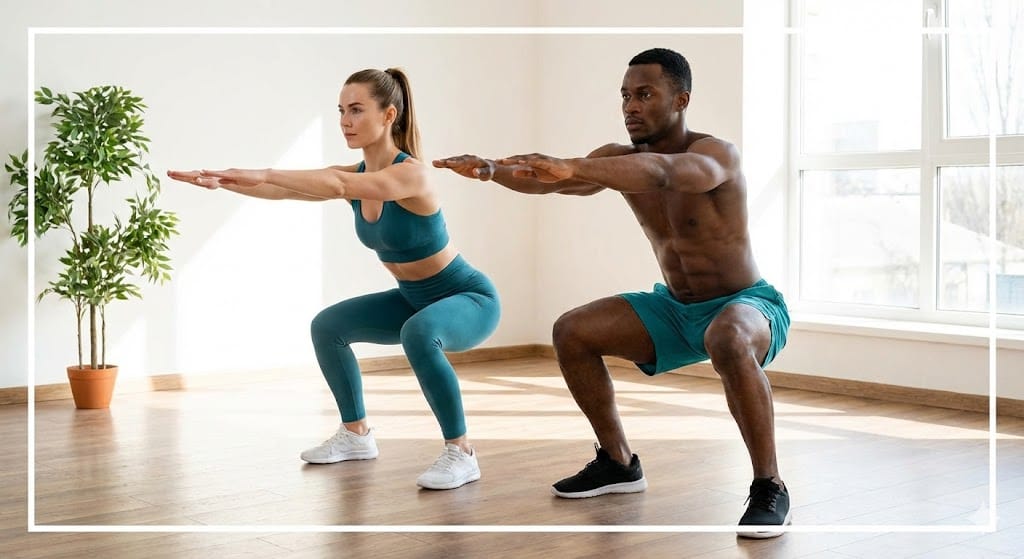
Lower-body training becomes dramatically harder when you shift from two legs to one.
Examples include:
- Bulgarian Split Squats
- Pistol Squats
- Shrimp Squats
- Single-Leg Romanian Deadlift
- Skater Squats
Each variation increases the demand on:
- Quadriceps
- Glutes
- Hamstrings
- Calves
- Core
- Balance
Single-leg exercises also challenge stabilising muscles that traditional machines often overlook.
Myth #4: You Need to Do 100 Reps to Build Muscle
One of the biggest misconceptions about bodyweight training is that you must perform endless repetitions before seeing results.
You’ve probably seen videos of people doing:
- 100 Push-Ups
- 500 Squats
- 1,000 Sit-Ups
While impressive, extremely high repetitions are not the secret to building muscle.
The Truth
Your muscles respond to challenge, not simply to repetition.
A controlled set of 8 to 15 difficult repetitions often provides a stronger muscle-building stimulus than 100 fast, easy repetitions performed with poor technique.
Think about it this way.
Would you rather perform:
- 15 slow Push-Ups with perfect control
- or
80 rushed Push-Ups using momentum?
Quality usually wins.
Why Time Under Tension Matters
One of the easiest ways to increase difficulty without adding equipment is to slow down each repetition.
Instead of this:
- ⬇️ Down quickly
- ⬆️ Up quickly
Try this:
- Lower for 3 seconds
- Pause for 1 second
- Press up over 2 seconds
Suddenly, even a regular Push-Up feels completely different.
This is called time under tension, and it’s a powerful way to increase muscular demand.
Try this challenge: Normal squats (10 repetitions) → slow squats (10 repetitions with a 3-second lowering phase).
Most people are surprised by how much harder the second version feels.
Slow, controlled Push-Up demonstrating time under tension for muscle growth.
Sanook Fit Coach’s Tip 💡
Don’t count repetitions.
Make your repetitions count.
Perfect technique always beats endless numbers.
Myth #5: Bodyweight Workouts Don’t Burn Fat
This myth has existed for decades.
Many people still believe the only way to lose fat is by spending hours on a treadmill.
Fortunately, that’s not how the body works.
The Truth
Want a focused routine to put this into practice? Try our guide to the best bodyweight workouts for abs to build a strong core at home.
Fat loss isn’t determined by the type of equipment you use.
It’s influenced by:
- Total daily energy expenditure
- Nutrition
- Muscle preservation
- Activity levels
- Long-term consistency
Bodyweight workouts contribute to several of these factors at once.
Why Full-Body Circuits Work
Exercises like:
- Burpees
- Mountain Climbers
- Squats
- Push-Ups
- Jumping Jacks
- Reverse Lunges
recruit multiple muscle groups simultaneously.
That means:
- Higher heart rate
- Greater calorie expenditure
- Improved cardiovascular fitness
- Stronger muscles
All in one workout.
What About the “Afterburn Effect”?
You’ve probably heard people talk about the “afterburn.”
The scientific term is Excess Post-exercise Oxygen Consumption (EPOC).
After higher-intensity exercise, your body continues using extra oxygen while it returns to its normal resting state. This increases energy expenditure for a period after the workout, although the effect is generally more modest than many marketing claims suggest.
Rather than chasing the afterburn, focus on consistent training and healthy eating habits. Those have a much bigger impact on long-term fat loss.
Fat Loss Reminder
No workout can:
❌ Burn fat from one specific body part.
The body decides where fat is lost.
Exercise helps create the conditions for overall fat loss.
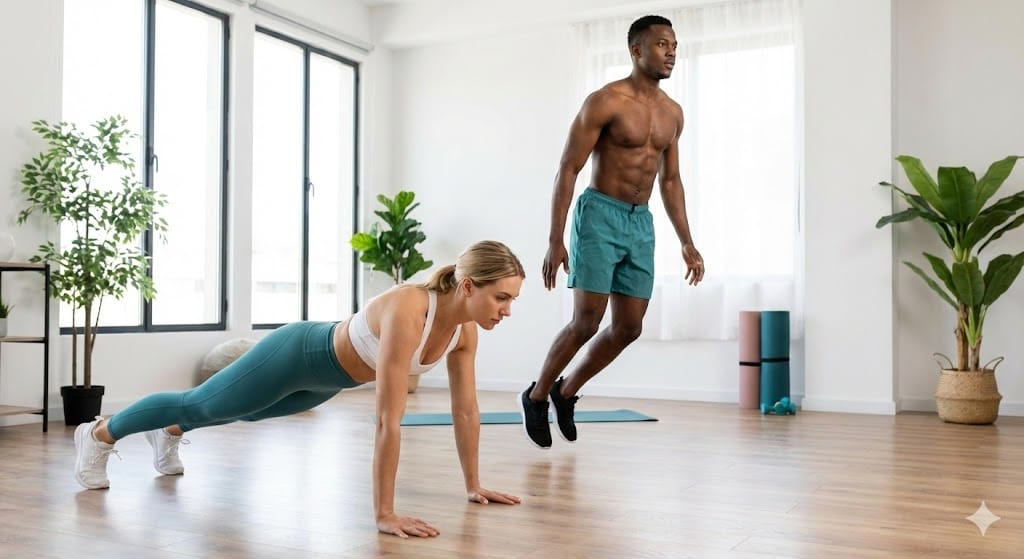
High-intensity bodyweight circuit supporting cardiovascular fitness and healthy fat loss.
Myth #6: Home Workouts Aren’t Intense Enough
Many people imagine home workouts look like this:
A few stretches.
Ten squats.
Finished.
Modern bodyweight training is very different.
The Truth
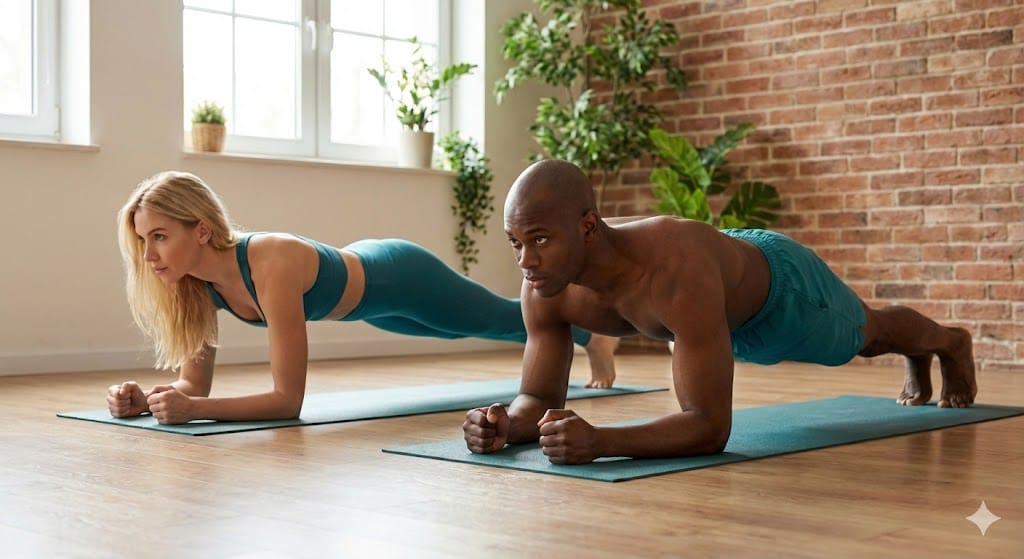
Intensity comes from effort.
Not location.
A challenging circuit such as:
- Burpees
- Push-Ups
- Jump Squats
- Mountain Climbers
- Plank
- Reverse Lunges
can elevate your heart rate within minutes.
Many experienced exercisers finish these sessions just as fatigued as they would after a gym workout.
Intensity Isn’t Always About Speed
Some people think harder means faster.
Not necessarily.
Intensity can come from:
- Slower repetitions
- Longer holds
- Single-leg movements
- Reduced rest
- Better technique
Sometimes moving more slowly makes an exercise much harder.
- Home Workout Example
- 3 Rounds
- 15 Squats
- 10 Push-Ups
- 12 Reverse Lunges
- 30-second Plank
- 20 Mountain Climbers
Rest 45 seconds.
Most people won’t call that easy.
Myth #7: You’ll Eventually Stop Making Progress
This myth usually comes from people who repeat the same workout for months.
The problem isn’t bodyweight training.
The problem is repeating the exact same challenge.
The Truth
Progress never stops if your exercises continue evolving.
Here’s one example.
Push-Up Progression
Wall Push-Up → Incline Push-Up → Floor Push-Up → Pause Push-Up → Decline Push-Up → Archer Push-Up → One-Arm Push-Up Progression
Each step increases the challenge.
Squat Progression
Chair Squat → Bodyweight Squat → Pause Squat → Split Squat → Bulgarian Split Squat → Shrimp Squat → Pistol Squat
Again, progression never stops.
Progress Doesn’t Always Mean Harder
Sometimes progress looks like:
- Better balance
- Improved mobility
- Cleaner technique
- Greater confidence
- Faster recovery
Those improvements matter just as much.
Myth #8: Cardio Is Better Than Strength Training for Weight Loss
This myth refuses to disappear.
Many people still think:
Cardio burns calories.
Strength training builds muscle.
The reality is more balanced.
The Truth
The most effective long-term approach usually combines both.
Strength training helps:
- Preserve muscle while losing weight
- Improve metabolism
- Increase functional strength
Cardio supports:
- Heart health
- Endurance
- Daily calorie expenditure
Fortunately, many bodyweight workouts naturally combine both.
Exercises like:
- Burpees
- Mountain Climbers
- Jump Squats
train your muscles while also challenging your cardiovascular system.
That’s one reason bodyweight circuits are so popular.
Which Is Better?
Instead of choosing between strength or cardio…
Choose workouts that include both.
That’s exactly how most Sanook Fit workouts are designed.
Sanook Fit Coach’s Tip 💡
Don’t ask whether bodyweight training is “enough.”
Ask whether you’re challenging yourself enough.
Your muscles don’t know where you train.
They only know how hard they’re working.
Myth #9: Bodyweight Training Is Only for Young People
This myth discourages thousands of people from becoming more active.
Many adults assume bodyweight training is only suitable for teenagers, athletes, or people who are already fit.
Nothing could be further from the truth.
The Truth
Bodyweight training can be adapted for almost every age and fitness level.
The goal isn’t to perform advanced calisthenics on your first day.
The goal is to move safely and progressively.
Exercises can be modified by:
- Using a chair for support
- Reducing the range of motion
- Performing fewer repetitions
- Slowing the pace
- Increasing recovery time
These small adjustments make bodyweight exercise accessible to beginners and older adults alike.
Why Strength Matters More as We Age
As we get older, maintaining muscle mass and balance becomes increasingly important.
Regular strength training can help support:
- Everyday mobility
- Joint stability
- Bone health
- Balance
- Confidence in daily activities
Simple movements like squats, wall push-ups, and step-ups can make everyday tasks feel easier.
Beginner Routine
If you’re just starting, try:
- Chair Squats × 10
- Wall Push-Ups × 10
- Standing Calf Raises × 15
- Bird Dogs × 10 each side
- Standing March × 60 seconds
Repeat twice.
Consistency matters more than intensity.
Myth #10: You Need One-Hour Workouts
Many people skip exercise because they believe they don’t have enough time.
If they can’t spare a full hour, they decide not to exercise at all.
The Truth
A shorter workout completed consistently is far more valuable than a perfect workout that never happens.
Even 15 to 20 minutes of focused movement can improve:
- Strength
- Fitness
- Mood
- Energy
- Mobility
Busy schedules don’t have to stop your progress.
Example 15-Minute Workout
Complete three rounds:
- 10 Squats
- 10 Push-Ups
- 10 Reverse Lunges each leg
- 20 Mountain Climbers
- 30-second Plank
You’ll train your entire body in less time than many people spend commuting to the gym.
Think Long-Term
Three 20-minute workouts each week add up to:
Over 50 hours of exercise each year.
Small sessions create big results.
Myth #11: The More You Sweat, the Better the Workout
We’ve all seen advertisements suggesting that sweat equals success.
It sounds convincing.
It just isn’t true.
The Truth
Sweat is your body’s cooling system.
How much you sweat depends on many factors, including:
- Temperature
- Humidity
- Clothing
- Genetics
- Hydration
- Exercise intensity
Some people naturally sweat more than others.
That doesn’t mean they had a better workout.
What Really Measures Progress?
Instead of judging your workout by sweat, ask yourself:
Am I getting stronger?
Is my technique improving?
Can I perform more repetitions?
Am I recovering faster?
Do I have more daily energy?
Those are much better indicators of progress.
Myth #12: If You’re Not Sore, It Didn’t Work
Delayed onset muscle soreness (DOMS) often gets mistaken for proof of an effective workout.
While soreness is common, especially after trying new exercises, it isn’t a requirement for progress.
The Truth
Muscles adapt.
As your body becomes more accustomed to training, you may experience less soreness even while continuing to make excellent progress.
Many experienced athletes complete productive workouts without feeling sore the next day.
Chase Progress, Not Pain
A successful workout is one that helps you improve.
Not one that leaves you unable to walk comfortably for three days.
Consistency always beats occasional extreme sessions.
Myth #13: Athletes Need Heavy Weights
Many people assume serious athletes never use bodyweight exercises.
The opposite is often true.
The Truth
Elite athletes across many sports regularly include bodyweight movements.
Why?
Because they improve:
- Relative strength
- Mobility
- Core stability
- Coordination
- Balance
- Movement quality
Sports that commonly use bodyweight training include:
- Gymnastics
- Martial arts
- Rock climbing
- Swimming
- Football
- Rugby
- Track and field
Bodyweight exercises complement many strength programs.
They’re not just for beginners.
Myth #14: You Need Perfect Technique Before You Start
This myth creates unnecessary fear.
People delay exercise because they’re worried about getting everything exactly right.
The Truth
Good technique is important.
Perfection isn’t required before you begin.
Every skilled exerciser once learned:
- Their first squat
- Their first push-up
- Their first plank
Technique improves through practice.
The key is to start with manageable variations and focus on gradual improvement.
Learn One Movement at a Time
Trying to master twenty exercises at once becomes overwhelming.
Instead:
Master one movement at a time:
Squats → Push-Ups → Lunges → Plank → Glute Bridge
Build confidence one movement at a time.
Myth #15: It’s Too Late to Start
Perhaps the most harmful fitness myth of all.
Some people believe:
“I’m too old.”
“I’ve been inactive for too long.”
“I’ve missed my chance.”
The Truth
Your body is remarkably adaptable.
While progress may happen at different rates for different people, positive changes can occur at almost any age.
Many adults begin exercising later in life and experience improvements in:
- Strength
- Mobility
- Balance
- Confidence
- Energy
- Overall quality of life
The best time to start may have been years ago.
The second-best time is today.
What Real Progress Looks Like
Forget unrealistic social media transformations.
Progress often looks like:
- Carrying shopping bags more easily
Walking upstairs without getting out of breath
- Playing with your children or grandchildren
- Sleeping better
- Feeling more energetic at work
- Standing taller with better posture
- Feeling more confident in your body
These improvements have a meaningful impact on daily life.
Proof That Bodyweight Training Works
You don’t have to rely on myths or marketing.
Look at people who regularly use bodyweight training:
- Gymnasts
- Calisthenics athletes
- Military personnel
- Firefighters
- Martial artists
- Rock climbers
Different goals.
Different professions.
One common theme.
Strong movement built through consistent training.
Sanook Fit Coach’s Tip 💡
The biggest limitation in bodyweight training usually isn’t your body.
It’s believing you can’t improve before you’ve even started.
Challenge the myth.
Then challenge yourself.
Myth #9: Bodyweight Training Is Only for Young People
This myth discourages thousands of people from becoming more active.
Many adults assume bodyweight training is only suitable for teenagers, athletes, or people who are already fit.
Nothing could be further from the truth.
The Truth
Bodyweight training can be adapted for almost every age and fitness level.
The goal isn’t to perform advanced calisthenics on your first day.
The goal is to move safely and progressively.
Exercises can be modified by:
- Using a chair for support
- Reducing the range of motion
- Performing fewer repetitions
- Slowing the pace
- Increasing recovery time
These small adjustments make bodyweight exercise accessible to beginners and older adults alike.
Why Strength Matters More as We Age
As we get older, maintaining muscle mass and balance becomes increasingly important.
Regular strength training can help support:
- Everyday mobility
- Joint stability
- Bone health
- Balance
- Confidence in daily activities
Simple movements like squats, wall push-ups, and step-ups can make everyday tasks feel easier.
Beginner Routine
If you’re just starting, try:
- Chair Squats × 10
- Wall Push-Ups × 10
- Standing Calf Raises × 15
- Bird Dogs × 10 each side
- Standing March × 60 seconds
Repeat twice.
Consistency matters more than intensity.
Myth #10: You Need One-Hour Workouts
Many people skip exercise because they believe they don’t have enough time.
If they can’t spare a full hour, they decide not to exercise at all.
The Truth
A shorter workout completed consistently is far more valuable than a perfect workout that never happens.
Even 15 to 20 minutes of focused movement can improve:
- Strength
- Fitness
- Mood
- Energy
- Mobility
Busy schedules don’t have to stop your progress.
Example 15-Minute Workout
Complete three rounds:
- 10 Squats
- 10 Push-Ups
- 10 Reverse Lunges each leg
- 20 Mountain Climbers
- 30-second Plank
You’ll train your entire body in less time than many people spend commuting to the gym.
Think Long-Term
Three 20-minute workouts each week add up to:
Over 50 hours of exercise each year.
Small sessions create big results.
Myth #11: The More You Sweat, the Better the Workout
We’ve all seen advertisements suggesting that sweat equals success.
It sounds convincing.
It just isn’t true.
The Truth
Sweat is your body’s cooling system.
How much you sweat depends on many factors, including:
- Temperature
- Humidity
- Clothing
- Genetics
- Hydration
- Exercise intensity
Some people naturally sweat more than others.
That doesn’t mean they had a better workout.
What Really Measures Progress?
Instead of judging your workout by sweat, ask yourself:
Am I getting stronger?
Is my technique improving?
Can I perform more repetitions?
Am I recovering faster?
Do I have more daily energy?
Those are much better indicators of progress.
Myth #12: If You’re Not Sore, It Didn’t Work
Delayed onset muscle soreness (DOMS) often gets mistaken for proof of an effective workout.
While soreness is common, especially after trying new exercises, it isn’t a requirement for progress.
The Truth
Muscles adapt.
As your body becomes more accustomed to training, you may experience less soreness even while continuing to make excellent progress.
Many experienced athletes complete productive workouts without feeling sore the next day.
Chase Progress, Not Pain
A successful workout is one that helps you improve.
Not one that leaves you unable to walk comfortably for three days.
Consistency always beats occasional extreme sessions.
Myth #13: Athletes Need Heavy Weights
Many people assume serious athletes never use bodyweight exercises.
The opposite is often true.
The Truth
Elite athletes across many sports regularly include bodyweight movements.
Why?
Because they improve:
- Relative strength
- Mobility
- Core stability
- Coordination
- Balance
- Movement quality
Sports that commonly use bodyweight training include:
- Gymnastics
- Martial arts
- Rock climbing
- Swimming
- Football
- Rugby
- Track and field
Bodyweight exercises complement many strength programs.
They’re not just for beginners.
Myth #14: You Need Perfect Technique Before You Start
This myth creates unnecessary fear.
People delay exercise because they’re worried about getting everything exactly right.
The Truth
Good technique is important.
Perfection isn’t required before you begin.
Every skilled exerciser once learned:
- Their first squat
- Their first push-up
- Their first plank
Technique improves through practice.
The key is to start with manageable variations and focus on gradual improvement.
Learn One Movement at a Time
Trying to master twenty exercises at once becomes overwhelming.
Instead:
Master one movement at a time:
Squats → Push-Ups → Lunges → Plank → Glute Bridge
Build confidence one movement at a time.
Myth #15: It’s Too Late to Start
Perhaps the most harmful fitness myth of all.
Some people believe:
“I’m too old.”
“I’ve been inactive for too long.”
“I’ve missed my chance.”
The Truth
Your body is remarkably adaptable.
While progress may happen at different rates for different people, positive changes can occur at almost any age.
Many adults begin exercising later in life and experience improvements in:
- Strength
- Mobility
- Balance
- Confidence
- Energy
- Overall quality of life
The best time to start may have been years ago.
The second-best time is today.
What Real Progress Looks Like
Forget unrealistic social media transformations.
Progress often looks like:
- Carrying shopping bags more easily
Walking upstairs without getting out of breath
- Playing with your children or grandchildren
- Sleeping better
- Feeling more energetic at work
- Standing taller with better posture
- Feeling more confident in your body
These improvements have a meaningful impact on daily life.
Proof That Bodyweight Training Works
You don’t have to rely on myths or marketing.
Look at people who regularly use bodyweight training:
- Gymnasts
- Calisthenics athletes
- Military personnel
- Firefighters
- Martial artists
- Rock climbers
Different goals.
Different professions.
One common theme.
Strong movement built through consistent training.
Sanook Fit Coach’s Tip 💡
The biggest limitation in bodyweight training usually isn’t your body.
It’s believing you can’t improve before you’ve even started.
Challenge the myth.
Then challenge yourself.
Start Where You Are, With Sanook Fit

You don’t need a gym, fancy gear, or perfect conditions to build real strength. You need a clear plan, a little consistency, and the willingness to start exactly where you are today. That’s exactly what we’re here to help you do.
Follow Sanook Fit for simple, no-equipment workouts, form tips, and encouragement that meets you where you are: